The trial by fire: drugs as a “shortcut” to enlightenment

There are several paths to enlightenment-each are suited to a particular personality. These provide the person with a path and exercises that are comfortable to them and give the most effective growth.

There are ways that are universal to all types of people, that provide rapid experience of enlightened states, and that are easy to use.

One method that can be used in this way is medicinal plants. Certain plants produce compounds that react with brain chemicals to produce certain effects that are similar to states produced by spiritual exercise.

These substances include: ayahuasca, rye ergot, peyote, psilocybin, san pedro cactus, jimson weed. All of these plants have been used by native cultures in ceremonial rites and by shamans to communicate with their deities.

These substances provide several functions that allow approximation with states of enlightenment.

– Energy raising-when using these plants, energy stored in lower energy states rises to higher states more easily. This allows for increased activity at those higher energy states.

– Altered perceptions-when under the influence of these substances, the force of everyday perception is lessened and more subtle perceptions are able to be used. This is an essential part of spiritual development.

– Peak experiences-these plants produce an experience similar to enlightenment-the wordless state of perception. While the plant influence is transitory, it provides a way to learn about the actual experience of at-one-ment.

There are, however, dangers with using these substances. Opening up perceptions and releasing energy are actions which can entrap the unprepared person.

– Overidentification with the altered state and reliance on it to provide actual attainment. This retards the progress of actual spiritual advancement.

– Losing perspective-falsely thinking that the experiences and perceptions gained during the experience are the only real experience. Inability to see the experience for what it is: an artificial method to gain experience in spiritual activity.

– Loss of control-without sufficient preparation and guidance, the power of these substances and the experiences generated are difficult to control. There is a risk of losing oneself in the experience and being unable to return to everyday life.

– Loss of self-as these plants open up the spiritual body, the risk of this body being taken by malevolent inhabitants of non-physical realms becomes a possibility if the user is not properly prepared or unable to control or defend himself.

– Loss of anchor-as energy is released by these plants, spiritual travel is possible. Without proper guidance or experience, the person can get lost during these journeys and be unable to find the way back to his physical body.

– Inappropriate progress-by the use of these substances, great progress in the acquisition of spiritual abilities can be made. There is a danger that these spiritual abilities will be gained without the corresponding spiritual discipline and control. Using these powers without discipline and control can lead the person to error and illusion.

Because of the many risks involved in this particular path, it is not recommended for most people. It is a violent and wrenching experience, and the benefits do not outweigh the risks. For this reason I call it the “trial by fire”, as coming out of it can leave you severely burned, or tempered into steel.

Keep in mind the words of Ram Dass (Richard Alpert)-“psychedelics are like a business call-once you get the information, you hang up the phone, if you’re smart.”

A physical regimen

Our physical body is the ground in which all our lives are based. Without the physical body, we are only spirit, unable to learn and advance along the path of enlightenment.

Our body is therefore the first most important body to develop and take care of when undertaking a spiritual path. It is a temple, and must be respected and revered as a sacred chalice that holds the secret of our life.

There are several aspects to physical fitness-cardio-vascular fitness, strength and flexibility, body control and skill, efficient bodily function.

Cardio-vascular fitness is
necessary for endurance-the ability to use your body for extended periods of time without tiring. Your heart, lungs and muscles need to be able to tolerate stress and work at elevated levels for some time and high levels without immediate failure. This is accomplished by continuous low-intensity activity of large muscles. The important item to recognize here is time. The exercise must continue for at least 20 minutes, 3 times a week.

Many types of exercise are good for cardio-vascular fitness. Some of them are: walking, cycling, swimming, skating, jogging.

Strength is important because of the need to use your muscles for work. Also, muscles need to be stressed or they lose their tone. The most efficient way to strengthen your muscles is through lifting weights. To properly strengthen your muscles, three things need to happen: first, the muscle is worked through its full range of motion; second, the muscle is worked hard where it is strong, less hard where it is weaker; and third, the muscle is worked until it fails. This type of strength training should be done 3 times a week.

Flexibility is the ability of your muscles and joints to stretch and move in unexpected directions without damage. Stretching is best done both before and after exercise, and ideally once a day as well. Stretching should be a consistent routine every time. It should process from the head to the toes or vice versa. Each stretch should be held a minimum of 10 seconds without pain. A good source of stretching exercises is hatha yoga.

The ability to make your body do what you will it to do is very important. This is done through activity which builds skills. Training in non-repetitive motion, muscle memory and fixed motions allows control over your body. Some important skills to learn are: balance, hand-eye coordination, precision movement, quickness, reflexes, strategy, use of power and finesse, ability to absorb punishment. Activities that promote these skills include: martial arts (soft and hard), ballet, tennis, rugby, golf, playing a musical instrument, typing, competitive driving, surfing, skating, hockey, among many others. In short, most any skilled activity is useful, but a balanced mix of activities is important to proper skill building.

Making your body work in the best manner is the goal of all these things. One final thing remains, and that is the health of your body. Proper diet, dental care, monitoring of cholesterol and regular checkups, in addition to preventive care will ensure that your body provides a good foundation for further development.

A yoga routine

Purification exercise

Visualize a being of pure light and love (Padmasambhava-Lotus-evolved one), who is sitting in the midst of a lake on a lotus flower in front of you. He is in front and slightly above you at a thirty degree angle. He will come into your heart when you have sufficiently purified yourself.

Closing your left nostril, breathe three deep breaths out of your right nostril. Visualize the air being ejected as dark red and consider it to be all of your bodily diseases and attachments.

Close your right nostril. Now breathe out three deep breaths through your left nostril. Visualize the air being ejected as blue-grey and consider it to be all your mental obstacles and anger.

Now breathe out three deep breaths through your mouth. Visualize this air as purple and consider it as the sloth that impedes your progress.

Now visualize that from the ajna (the point between the eyebrows) of Padmasambhava directly to your ajna there is a piercing beam of white light which, as it burns into you, rids you of bodily sins and wrongs (the sound connected with this is OM).

Now visualize that from the throat chakra of Padmasambhava directly to your throat chakra there is a piercing beam of red light which, as it burns into you, rids you of lapses of speech and untruths (the sound connected with this is AH).

Now visualize that from the heart of Padmasambhava directly to your ajna there is a piercing beam of blue light which, as it burns into you, rids you of wrongs done in ignorance and wrong thoughts (the sound connected with this is HUM).

Now allow that blue beam to become a broad blue avenue of light. Then you will see Padmasambhava come down that avenue and come directly into your heart. Here he will sit in your hridayam (spiritual heart). His mantra is Om Ah Hum Vajra Guru Padma Siddhi Hum. This means three-in-one (the unmanifest, imminent manifestation, and manifestation) lightning-bolt Guru of unbearable compassion and infinite power who resides in my heart. To say his mantra is to keep Him in your heart until finally you and He become One.

The Four Bodhisattva Vows (say three times)

I resolve to become enlightened for the sake of all living beings

I will cut the root of all delusive passions

I will penetrate the farthest gate of Dharma

I will realize the supreme way of Buddha

Asanas

Lie flat on your back and relax. Legs out straight, feet together and your hands by your sides. Relax your feet, calves, thighs, pelvis, abdomen, chest, arms, neck and head.

Extend your arms very slowly over your head until they are stretched out straight behind you. Slowly sit up, bringing your arms and head up together and keeping your heels on the ground. Bend at the waist.

Smoothly proceed forward until you touch your toes. Keep your legs straight. If you can, hold your feet with your hands, pulling your feet towards you and bending your elbows until they are touching the ground on either side of your legs.

Gently raise your arms and return to a prone position, inhaling.

Work up daily until you are doing about thirty of these.

Sit up with your legs stretched out in front of you. Now bend your left leg and place the sole of your left foot against the inside of the thigh of your right leg (still straight). Maintain that position. Raise your arms over your head and bring them slowly down towards your right foot. Bend as low in the back as possible. Then hold the position for about 15 to 30 seconds and return to a straight sitting position.

Now change legs so that the left leg is extended and the right is bent.

Roll over on your stomach and lie flat with your legs together and your hands by your sides. bend your arms until your hands are flat on the floor next to your chest. Very gently start to push up with your forearms, thus raising the upper part of your body. Raise your head first, then your neck, and then slowly raise lower and lower parts of your spine.

At the same time that you are raising the upper part of your body, press down into the ground with your pelvis. You will finally feel the pressure at the tip of your spine.

Keep your head up. When you have reached the point that you can reach comfortably, stop and remain and then remain in that position for about 15 seconds and then lower the upper part of your body to the ground.

Sit up and cross your legs.

Place your hands behind you and slowly let yourself back down until you are resting on your elbows. Lower your head until the top of your head touches the ground. Arch your back and rest the upper part of your body on the top of your head and the lower part of your body on your cross-legged seat. Now place your hands lightly on the top of
your thighs. Remain in this position for about 15 to 30 seconds and then slowly return to a sitting position. Continue forward until your head is on the floor and your shoulders are resting on your thighs. Holding the wrist of one arm with the hand of the other behind your back, slowly raise your arms behind you as high as you can. Then bring them down and relax.

Roll over on your stomach. Behind your back take hold of your ankles with your hands, firmly. Push away with your feet, bringing your head and chest up. Keep lifting in this fashion until your thighs are fully off the ground. Look straight ahead and remain in that position for about 15 to 30 seconds. Gently return to the ground. Do this three times.

Sit up straight with your legs straight out before you on the floor. Bend your left knee and put your left leg under your right leg so that the left heel is to the right of and pressed against your right cheek. Bring your right leg up by bending it at the knee and place the right foot flat on the ground to the left of the left knee.

Raise your left arm and twist the upper part of your body to the right until your left armpit is directly over your right thigh. Now turn your left forearm so that you can pass it through the triangle made by the bend in your right knee. At this point your left armpit is almost resting on top of the right thigh.

Reach around behind you with your right arm until your right and left hands can grip each other. Turn your head so that you are looking behind you over your right shoulder. Twist as far as possible. Hold the position for 15 to 20 seconds and return to as straight sitting position.

Now do the twist to the left, reversing the above instructions.

Assume a kneeling position. Place your hands on your knees so that your fingers are extended outwards and you are leaning slightly forward.

Extend the tongue outward as far as possible and turn the eyes upward and towards the middle of the forehead. Exhale the breath as much as possible and contract the throat muscles. Make the entire body as taut as possible-as if you were a lion about to spring. Stop, return, and then relax. Repeat about four times.

Lie on your back. Raise your legs off the ground and spread them, keeping them straight. Then raise the upper body to form a V with the point of contact with the ground being the tip of your spine. Stretch your arms forward between your spread legs. Remain in this position for 30 seconds. Don’t strain. Return to a relaxed position.

Lie on your back. Very gently, in one smooth movement, lift your legs off the ground (keeping the straight) And raise them until they are at a 90 degree angle to your torso. Then placing your hands behind your back, slowly lift your hips off the ground and more and more of your back, until only your head and neck and on the ground. Your back is supported by your hands, which should be as high up (close to the neck) on your back as possible. Elbows are on the ground. Remain with legs and body straight up for two minutes.

Starting from the neck stand, gently bring legs over the head, still keeping them straight, until your toes touch the ground behind your head. Keeping your legs straight, attempt to bring your heels to the ground and walk in towards your head. When you have gotten as close as possible without straining, stop for 10 seconds.

Starting from the last position, bend your knees until they touch the floor next to your ears. Remain in that position for ten seconds. Then gently retrace your steps, one by one, until you are back on the ground resting on your back. As you lower your body, press each vertebrae against the ground from the neck down.

Return to the first position and remain there for five minutes

Pranayamas

Sit upright, lotus position is ideal.

Pull in and up on the sphincter.

Pull in slightly on the stomach.

Extend the tongue out of the mouth as far as possible. form it in a “U” shape. Breathe in through the mouth as deeply as is comfortable.

During the inhalation, imagine that you are bringing pure pran or life force or light or consciousness into your body. Focus on the point between the eyebrows so that you experience bringing the pran to that point. As you breathe out, imagine breathing out impurities of body and mind.

Do five of these the first day. Increase by one each day until you are doing fifty a day.

This breathing involves a rhythmic shallow breathing through the nose only. There is no pause between inhalation and exhalation. You start slowly in order to keep the in-breath and out-breath of equal intensity and duration. Once you have equated them, increase the rate and intensity. Ultimately the breath is short and staccato in neture with a definite feeling of impact at the points between the in-breath and the out-breath.

During this exercise focus in the inside of the tip of the nose at the point where the air hits the nasal passage during exhalation.

Do this exercise for about thirty seconds. Stop, rest. Do it again for about thirty seconds. Later, you can increase the number of intervals to three or four at a sitting.

Place the right hand so that the third finger is resting between the eyebrows, the thumb is by the right nostril, and the fourth finger is by the left nostril. Close the right nostril with the thumb and inhale slowly and evenly through the left nostril (about four seconds). Hold the nose by closing both nostrils for about 2 seconds. Remove the thumb and exhale slowly and evenly through the right nostril (about 8 seconds). After a second, inhale through the right nostril (about 4 seconds), hold 2 seconds, and exhale through the left nostril (8 seconds).

As you take in the breath through your left nostril, imagine a charge of energy going down the ida (a nerve on the left side of your spine). As you hold the breath for the two seconds, imagine that the charge of energy is coming up the pingala (a nerve on the right side of the spine).

Start with five of this exercise on the first day and increase to fifty a day.

A stretching routine

Preliminaries

It is important to follow a few precautions while stretching.


– A stretch should extend to a point where the stretch is slightly uncomfortable, never to pain.

– Hold a stretch, never bounce.

– Keep a stretch for a minimum of 10 seconds, preferably 30 seconds, and for overly tight muscles, 1-2 minutes.

– Slowly go in and out of the stretch, don’t jerk into a stretch.

Following these guidelines should lessen the chance of pulled and strained muscles.

Now, let’s do some stretching.

1. Take a comfortable stance with the knees bent and shoulder width apart. Relax through your entire body.

2. Take your left arm over your head and place your left hand over your right ear and gently pull your head to the left. Slowly pull your head down and forward, moving your hand to the back of your head, until your head faces downward. Switch hands and pull your head up and to the right, moving your hand to the left ear, until your head is tilted to the right. Slowly pull your head down and forward, moving your hand to the back of your head, until your head faces downward. Switch hands and pull your head up and to the left, moving your hand to the right ear, until your head is tilted
to the left.

3. Repeat step 2. without your hands.

4. Circle your shoulders twice clockwise and twice counterclockwise.

5. Windmill your arms twice clockwise and twice counterclockwise.

6. Clasp your hands behind your back and straighten them out. Slowly pull them up.

7. Place your hands above your head and against a wall. Lean forward, stretching your arms above your head. Remember to keep your back rounded.

8. Return to your stance with the knees bent and shoulder width apart. Place your right arm next to your right ear. Bend the elbow and place your left hand on top of the elbow. Pull the elbow slowly to the left. This stretches the back of the right arm (tricep). Repeat with your other arm.

9. Put your right arm across your body. Put the left hand behind the elbow and pull the elbow towards your left side. Keep the right shoulder down. This stretches the shoulder (deltoid). Repeat with your other arm.

10. Put your right arm in the air and bend to the left. This stretches your right side, so remember to lean from the waist and keep your hips level. Repeat with the left arm, leaning to the right.

11. Clasp your hands in front of you and raise them above your head, pushing them out. Lower them, pushing out. This stretches your upper back, so push forward with enough force to feel the stretch.

12. Lay on your stomach. Put your hands by your sides and push up, leaving your hips on the ground. Hold and lower your body to the ground. This will stretch your stomach. WARNING: Do not do this stretch if you have back problems. It compresses your lower back, which can cause damage if you have back problems.

13. Turn over to your back and pull your feet up. Turn your knees to the right and your shoulders to the left. Keep your back straight. this stretches the left side stomach muscles (obliques). Slowly bring the knees up and over to the left, reversing the stretch.

14. Straighten the legs and come to a sitting position. Lean over your legs, stretching out the lower back.

15. Roll over onto your stomach. Push up with your arms and place your right thigh on your chest, with your foot slightly in front of the knee. Push down with your hips. This stretches the front and back of the thighs.

16. Curl the left leg so that the left calf is near the left thigh. Adjust your left leg so that the left thigh is on the ground instead of the left knee. WARNING: The left knee must not be on the ground. This could cause knee damage. Slowly pull on the left foot with the right hand. This stretches the left thigh. Left go and bring the left foot back to the ground.

17. Repeat #15 and 16 with the other leg.

18. Sit up with your legs straight in front of you. Bend your left knee and put your left heel to the right of and pressed against your right buttock. Bend your right leg and place the right foot flat on the ground to the left of the left knee. Raise your left arm and twist your body to the right until your left armpit is directly over your right thigh. Turn your left forearm so that you can pass it through the triangle made by the bend in your right and your left armpit is almost resting on top of the right thigh. Reach behind you with your right arm until your right and left hands can grip each other. Turn your head so that you are looking over your right shoulder. Twist as far as possible.

19. Repeat the opposite way.

20. Sit up with your legs straight in front of you. Bend your left leg and place the sole of your left foot against the inside of the thigh of your right leg. Raise your arms over your head and bring them slowly down towards your right foot. Bend as low in the back as possible. Hold the position for 1 minute and return to a straight sitting position.

21. Repeat with the other leg.

22. Sit up with your legs straight in front of you. Grab the right toe with your right hand and pull it towards you. Repeat with the other foot.

23. Bring your feet together in front of you. Place them sole to sole as close to you as possible. Hold onto the ankles and push down on your knees with your elbows. Hold the position for 1 minute.

Weightlifting Routine

Strength training is one of the foundations of physical fitness. The following is an approach to strength training.

I prefer to use Nautilus machines, because they provide the most complete workout. You can use them if you prefer, or any other type of weights.

The routines described here provide a balanced workout. This routine is originally described in The Nautilus Book” by Ellington Darden. I put them on a set of laminated cards, with another card to record weights and reps. Email me if you want me to make a set for you. Darden has a new concept called 30-10-30 (also 10-10-10). It’s a shortened routine, 30 seconds negative, 8-12 reps at 1 up 2 down pace, then a final 30 seconds negative. It’s a bit limited, as it’s not really a whole body workout, and might work better if you slot it into the negative routines…

For a complete workout routine, I do a half hour cardio, alternating between a run, a HIIT, and rowing/elliptical/cycling/stairs, then the Nautilus routine, then the stretch routine, then Tai Chi. I do this three times a week.

I did Pilates for awhile back when it got popular. It’s been around since the 40’s, mostly used by dancers. It combines stretching with dynamic movements to give a combination workout-some muscular stress, stretching and cardio. It’s based on calisthenics, and was originally called “Contrology”, because really high control of movements was key. I would suggest it if you don’t have a lot of time and want to keep in shape-you can get a good workout in 15 minutes. I have a laminated set of pages with the 34 core Pilates mat exercises-email me.

I also have a quickie 6 minute workout if you’re interested. It’s really simple.

  • one minute of high steps
  • one minute of trunk rotation
  • 20 deep squats
  • 20 rear lunges
  • 30 sec of side bridge each side
  • 30 sec of pushup position

I think this is best done every other day, but every day might be better.

I’ve also discovered the Tibetan 5 Rites. It’s a little more involved than the short one, but shorter than Pilates. Here it is (all go up to 21 reps):

  1. Stand with arms outstretched horizontal to the floor, palms facing down. Spin around clockwise until you become slightly dizzy. Inhale and exhale deeply.
  2. Lie flat on your back. Stretch your arms along your side and place your palms on the floor, fingers close together. Raise your head up, tuck your chin. Lift your legs, knees straight, straight up. Extend your legs towards your head, legs straight. Slowly lower legs and head to the floor, knees straight. Relax, and repeat. Breathe in deeply as you lift and exhale as you lower.
  3. Kneel, body erect. Hands on the backs of your thigh muscles. Tilt head and neck forward, tuck chin into the chest. Throw the head and neck backward, arch the spine. Toes curled under. Brace your arms and hands against the thighs. Return to an erect position. Inhale as you arch and exhale as you return.
  4. Sit down, legs straight out, feet about 12″ apart. Place your palms alongside your backside. Tuck the chin forward. Drop the head backward. Raise your body-knees bend, arms straight. Tense every muscle. Relax and return to sitting. Rest. Breathe in going up, hold your breath as you tense, and breathe out going down.
  5. Lie down, face down. Hands palms down, toes flexed. Hands and feet are straight. Push up with arms perpendicular to the floor, spine arched, cobra position. Throw the head back as far as possible. Bend at the hips and bring the body into an inverted “V”. Bring the chin forward and tuck it against the chest. Breathe in deeply as you raise the body, and exhale fully as you lower the body.
  6. Stand straight and breathe out completely. Bend over forward putting your hands on your knees, forcing out the last trace of air. With your lungs empty return to standing straight posture. Put your hands on your waist and push your shoulders up by pressing down with your hands. Pull the abdomen in as much as possible and raise your chest, keeping your lungs empty. Hold this position as long as you are capable, with empty lungs. Breathe in through the nose until your lungs are full. Exhale through the mouth, relaxing arms to hang free. Take several deep breaths before the next repetition.

Here’s another set I used to do during work-I was standing all day and walking back and forth from work and home to public transit. It seemed to work pretty well for me.

0
Squat-Pushup-Crunch
7
Step
15
Cloud hands-Pull up-Crunch
23
Stretch
30
Squat-Overhead press-Crunch
37
Step
45
Cloud hands-Rowing-Crunch
53
Stretch

Here are the guidelines:

Step: about 30 seconds of high stepping.
Squat: 8-15 medium to low squats.
Lunge/Cloud Hands: 8-15 side to side lunges or cloud hands (from t’ai chi). Low position.
Stretch: Stretch calves, adductors, hamstrings, quads, twist, lean, arms up, arms back, delts, neck-5 sec for each (I do 10 secs for my hamstrings)
Pushup/overhead press: 8-30 repetitions, depending on weight and fitness level.
Crunch: 8-24 repetitions depending on fitness level. I do mine standing.
Pullup/Row: 8-15 repetitions, depending on weight and fitness level.

Here are some general guidelines for using the Nautilus routines.

  • Alternate BASIC ROUTINE 1 with the other 5 basic routines.
  • Do a NEGATIVE workout once a week.
  • Do a CHANGE-OF-PACE routine once a month.
  • Do each exercise for 1 set, 12 to 15 reps for legs, 8 to 12 reps for arms. If you do +12 or 15 good reps, increase weight.
  • The 9-12th (12th-15th) reps should be to FAILURE. Darden says the last one should be SUPREME EFFORT.
  • Substitute exercises if you can’t use a machine (eg., bent rows for rowing torso, shoulder machine for 70 shoulder, leg lifts for hip flexion, etc.)
BASIC ROUTINE I

Duo Hip and Back
Hip Adduction
Leg Extension
Leg Curl
Pullover
Behind Neck Pulldown
Lateral Raise
Overhead Press
Neck and Shoulder
Arm Cross
Decline Press
4-Way Neck

BASIC ROUTINE II

Hip Abduction
Leg Extension
Leg Press or Duo Squat
Calf Raise
Behind Neck
Behind Neck Pulldown
Dip
Rowing Torso
Multi-Triceps Extension
Multi-Biceps Curl
Abdominal
Lower Back

BASIC ROUTINE III

Side Leg Curl
Hip Adduction
Leg Press or Duo Squat
Hip Flexion
Pullover
Overhead Press
Chin or Negative Chin
Dip or Negative Dip
Wrist Curl
Reverse Wrist Curl
Abdominal
Rotary Torso

BASIC ROUTINE IV

Hip Flexion
Leg Extension
Leg Press or Duo Squat
Leg Curl
Calf Raise
Lateral Raise
Overhead Press
Pullover
Behind Neck Pulldown
Arm Cross
Decline Press
Neck and Shoulder

BASIC ROUTINE V

Hip Adduction
Hip Abduction
Duo Hip and Back
Hip Flexion
Behind Neck
70 degree Shoulder
Decline Press
10 degree Chest
Triceps Extension
Compound Position Biceps
Abdominal
Lower Back

BASIC ROUTINE VI

Leg Press or Duo Squat
Leg Extension
Calf Raise
Leg Curl
40 degree Chest/Shoulder
Lateral Raise
Pullover
Duo Decline Press
Wrist Curl
Reverse Wrist Curl
4-Way Neck
Rotary Neck

NEGATIVE ROUTINE I

Leg Extension (Lift w/two, lower w/one)
Leg Press (Lift w/two, lower w/one)
Leg Curl (Lift w/two, lower w/one)
Hip Adduction (Lift w/two, lower w/one)
Pullover (Negative Only)
Chin (Negative Only)
Lateral Raise (Negative Only)
Overhead Press (Negative Only)
Neck and Shoulder (Light weight, push down)
Dip (Negative Only)

NEGATIVE ROUTINE II

Hip Abduction (Light weight, push down)
Leg Curl (Light weight, push down)
Leg Press (Light weight, push down)
Leg Extension (Light weight, push down)
Rowing Torso (Light weight, push down)
Decline Press (Negative Only)
Pullover (Negative Only)
Overhead Press (Lift w/two, lower w/one)
Abdominal (Negative Only)

CHANGE OF PACE ROUTINE I

Overhead Press
Chin
Duo Decline Press
Pullover
Dip
Rowing Torso
Leg Extension
Leg Curl
Triceps Extension w/Towel
Compound Position Bicep
Hip Flexion

CHANGE OF PACE ROUTINE II

Leg Press (Seat Back)
Pullover
Leg Press (Seat Close)
Behind Neck
Calf Raise
Abdominal
Dip
Triceps Extension
Chin
Biceps Curl
Lower Back

ABDOMINAL ROUTINE
EXERCISE REPS SPEED
Hanging leg raises 12 med
Hanging knee-ups 5 med
Rest 10 seconds
Hanging leg raises 10 med
Hanging kneeups max med
Lying leg raises 30 med
Rest 10 seconds
Lying leg raises 20 med
Cross crunch max slow
Abdominal crunch max slow
1/4 situps 15 fast
Knee rock-back 20 med
DEFINITIONS
Hanging leg raises Hang from a bar, raise slightly bent legs almost to chest. MAKE SURE BACK IS ROUNDED.
Hanging kneeups Hang from a bar, lift bent legs to chest.
Lying leg raises Place hands under pelvis. Raise and lower legs from 12″ to 18″ above floor. MAKE SURE BACK IS ROUNDED.
Abdominal crunch Bent knee situp position. Raise shoulders and upper back off the ground, hold and lower. Rest hands on neck but DO NOT PULL.
Cross crunch Abdominal crunch but turn elbow and shoulder towards opposite knee.
1/4 situps Abdominal crunch but raise knees to a right angle from floor.
Knee rock-back 1/4 situp position. Lift legs up and to the chest.
30-10-30 ROUTINE

Leg Curl
Squat
Calf Raise
Pulldown
Bench Press
Curl
Overhead Press
Reverse Curl

The Diet

This “diet” isn’t really a diet in the usual sense of the word. It is a diet in the proper sense of the word, though.

Diet-n. 1. The usual food and drink of a person or animal; daily sustenance.

This is what I mean when I say “diet”-what you normally eat, day in, day out. This essay is an attempt to show a way to diet.

This way to eat is simple, easy, saves your body and the environment. All of the people of the world have eaten like this for millennia. Most non-Western people still do!

Follow me through “the diet…”

Until the beginning of the 20th century, most peoples of the world ate simple foods, based primarily on farm crops. Meat was a luxury, used sparingly or only on special occasions. You ate hunted meat, and used farm animals for their products (e.g., milk and eggs) until they weren’t productive, then you ate them. A lot of preservation was done too-salting, pickling, smoking. Only in this century has this diet changed.

There are several reasons why this has happened. Refrigeration, large industrial farming, urbanization, mass production and distribution are some of the root causes.

Unfortunately, this new diet, heavy on highly refined foods, meat and dairy products, and canned goods has been the direct or indirect cause of many, many deaths. And it is spreading from the West to the rest of the world. And with it, heart disease, strokes, cancer, “modern” diseases, lifestyle diseases. While diet may not be the sole cause, it has a significant effect. A proper diet, combined with exercise, stress reduction and a healthy attitude, can reduce lifestyle diseases.

Diet is the first of three pillars. Physical fitness is the second of these pillars. The third, middle pillar is mental and spiritual fitness. Diet is the foundation.

Your body is made from the food you eat. Every single cell is built from what you put in your mouth, digest, and assimilate. Proteins are the building blocks of all cells, carbohydrates (sugars) are the energy to do work, fats are the energy storehouses, and vitamins and minerals are catalysts and trace elements.

To be honest, where these nutrients come from makes very little difference, if they come in the proper form and correct balance.

Unfortunately, the “Western” diet has not provided this form and balance. Foods like beef, whole milk, french fries, ice cream for dessert-the basis of the “fast food” meal and the traditional “steak and potatoes” meal don’t provide this.

What they do provide is fat in double the amount you actually need, protein in one and one-half times the amount you actually need, carbohydrates in a form too easily absorbed (refined sugar), and vitamins, minerals, and bulk in less than half the amount you need.

The Western diet is out of balance. Of course, this begs the question-what is a balanced diet?

Current research has come up with the following formula-1/3 protein, 1/2 starches, 1/6 fat. Of course, these are approximate figures, but nonetheless form a start, a basis to judge a diet.

So, what’s the diet? It’s simple, but requires a fundamental change in outlook.

If you live in the West, you were brought up with a specific view of what foods are healthy and nutritious. You learned the four food groups (FFG).

Let’s think about the FFG for a second. Meat, dairy, grains, and fruits/vegetables. I said above that meat and dairy products are the basis of the Western diet, and are what is wrong with it. Half of FFG are made of these foods!

So, let’s remove meat and dairy from FFG. This leaves grains and fruits/vegetables. Next, let’s split fruits and vegetables into two groups. This gets us grains, fruits and vegetables as the three food groups.

This is fine, except for one small problem. This diet would be incomplete. By this I mean that it wouldn’t provide complete servings of protein. This is because grains only provide about half of necessary protein.

To add the other half of necessary protein, legumes (beans) have to be added to the three food groups. This is good, because we now have four groups.

The groups are now grains, legumes, fruits and vegetables. This is the “diet”. Simple, isn’t it?

Now, let’s get down to the concrete elements of this diet. It’s fine to say, “the four food groups are grains, legumes, fruits and vegetables”. Let’s put some flesh on that sentence.

Here are a sample of foods from each of the new four food groups (FFG2).

Grains

barley, millet, oats, rice, sorghum grain, rye, soybeans, buckwheat, bulgur, corn, triticale, wheat

Legumes

azuki beans, black beans, black-eyed peas, brown beans, chick peas, great northern beans, kidney beans, lentils, mung beans, navy beans, peas, pinto beans, red beans, soybeans, split peas, tempeh, miso

Fruits

apples, apricots, bananas, blackberries, blueberries, boysenberries, cantaloupe, casaba cherries, cranberries, currants, dates, figs, grapefruit, grapes, guava, honeydew melon, limes, loganberries, mangoes, nectarines, oranges, papayas, peaches, pears, pineapples, plaintains, plums, pomegranates, prunes, raisins, raspberries, strawberries, tangelos, kiwi fruit, kumquats, lemons, tangerines, watermelons

Vegetables

artichokes, asparagus, bamboo shoots, beets, broccoli, brussels sprouts, cabbage, carrots, cauliflower, celery, chili peppers, collards, corn, cucumbers, eggplant, escarole, garlic, ginger root, jerusalem artichoke, tomatoes, turnips, watercress, kale, leeks, lettuce, mushrooms, mustard greens, okra, onions, parsley, potatoes, pumpkin, radishes, rutabagas, scallions, shallots, sorrel, spinach, sprouts, squashes, sweet potatoes, swiss chard, yams, zucchini

This diet is complete, but to a Western palate, boring. Fortunately, the entire universe of sauces, spices and preparation can be used to enliven the food (this includes fats, oils and sweetenings.) Most other cultures are happy with it, and you can be happy with it as well.

There are other considerations to keep in mind when choosing food. The aphorism “you are what you eat” can serve to point this out. Much of the food we eat comes from far away and is mass-produced. This needs to change. How do we go about this? One way is to keep in mind the following seven ideas about food: whole-unprocessed; fresh, natural, organically grown-not canned or frozen, free of additives; in season-our bodies should eat what suits the season; local-riper, more nutrients, seasonal; in harmony with tradition-what we’re attuned to; balanced-variety in flavors, colors, textures; delicious-a guide to what our bodies need.

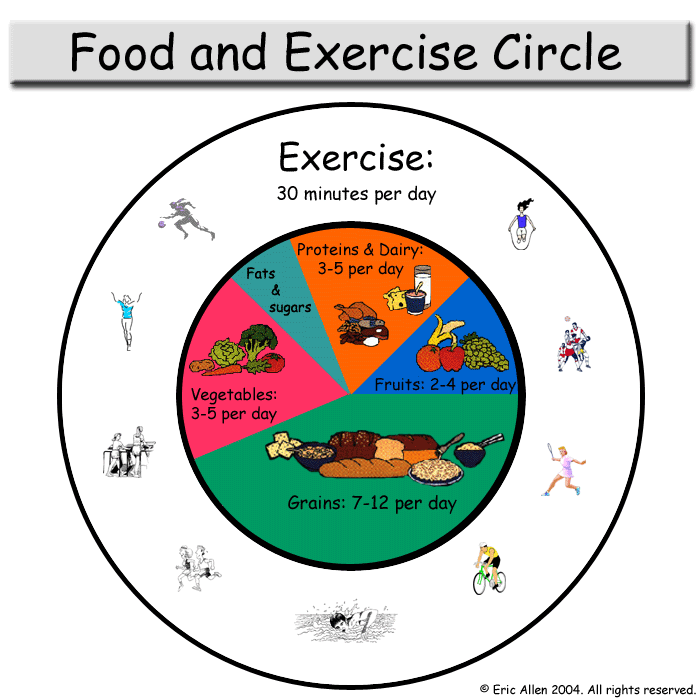
UPDATE: The U.S. Government comes up with new dietary guidelines every five years. In 2004, this has been more public than before, and marred by industry interference, especially from the sugar, dairy and cattle lobbies. In an attempt to make this diet a bit easier to quickly grasp, I have developed the following chart as a replacement for the food pyramid that is used now. I have adapted it, changed it into a circle, and added exercise as a key component surrounding the food circle. Since the big fad at the moment is “low carb/keto”, this circle is essentially opposite those recommendations. I won’t go too much into why low carb is bad other than to say that carbs are where you get your energy. Low carbs, low energy-you basically have to tap into non-carb resources for energy, which is wasteful and potentially dangerous, especially for those in bad health. There’s also a lot wrong with “going on a diet”-you need to change your diet permanently and increase exercise to permanently lose weight and keep it off, not to mention the health problems associated with dieting.

Here’s the chart-enjoy. Diet Circle
One of the things that’s been hot forever is supplementation. The problem with that is that it’s commonly used to prop up an insufficient diet. Having said that, there are some things you can add to your diet that might help things out a bit.

  • Pomegranates help, and are popular right now. Eat them straight, rather than juicing them.
  • Red wine and heavy beer in moderation help too.
  • Wheat germ
  • Brewer’s yeast
  • Parsley
  • Yogurt-get the natural kind-it’s more runny than the processed kind.
  • Bee pollen
  • Ginseng
  • Bach flower essences
  • Choming flower, tree and gem essences
  • Turmeric
  • Omega-3
  • Coenzyme Q-10

Emotional/mental regimen

As part of a total system of physical and spiritual development, a program to develop the mind must be included, as the mind controls the body in many respects. The mind (and emotions) are how sensations are interpreted and the facility that generates and controls actions. Thus, as the middle point between body and spirit, the mind must receive the same sort of development that the other parts do.
There are several activities and exercises that can help to develop the mind and emotional parts of a person.

  • Record and contemplate your thoughts and emotions. Keep a journal of them, reviewing each day and writing and thinking about it.
  • Record and contemplate your dreams in the same way. Write them down immediately upon waking.
  • Do a specific set of exercises upon waking and before sleep. For a summary, see the essay “A Yoga Routine”.
  • Read and think about selected passages from the great religious texts. Meditate, concentrate and contemplate on their meanings, the issues that they represent and what they mean to you.
  • Perceive your thoughts and emotions as you have them, but as a dispassionate observer. You also need to experience them fully as they appear and disappear. This is a dual task and there must be no conflict-each thought and emotion must be simultaneously experienced and observed.
  • Limit and control your emotions and thoughts. Damp the ferocity and impact of them as they appear in you. Let them dissipate without leaving a trace in your mind.
  • Begin to control your thinking and feeling “wrong” thoughts and emotions-judgments, insults, covetousness, hate, fear, anger, irritability, timidity, prejudice, vanity. Limit your thinking and feeling to “good” thoughts and emotions-happiness, joy, love, calmness.
  • Begin to control your speech. Speak only when you have something important to say. Don’t impart unnecessary or useless information.
  • Take some time every day to still your thoughts.
  • Periodically review your actions and take stock of your “good” and “bad” actions.

These activities will give you control and allow you to begin to develop the more subtle sensations associated with spiritual perception.

Also helpful is this variant of the Buddhist “Eightfold Path”
Right:

·     Thinking Admit only significant ideas and thoughts. Learn gradually to separate the important from the unimportant, the real from the unreal, the eternal from the ephemeral, the true from the false. Listen to what people say with inner quietness, refraining from approving or disapproving judgment and from criticism. In this way one arrives at the habit of forming opinions that are not influenced by sympathy or antipathy.
·     Intention Cultivate steadfastness. Make resolutions only after full consideration of even the most insignificant points. Avoid thoughtless acts and meaningless ones. For every act have sufficient reasons. Do no needless thing. When convinced of the rightness of a resolve, abide by it unfalteringly.
·     Speech In speech with others, say only what has sense and meaning. Make your conversation thoughtful. Do not be afraid to be silent often. Try not to use too many or too few words. Never talk for the sake of talking, or merely to pass the time.
·     Action Make your actions as far as possible harmonious with your surroundings. Weigh all actions carefully so that the eternal may speak through them, so that they may be good for the whole and for the lasting welfare of others.
·     Livelihood In the management of life, seek to live in conformity with both nature and spirit. Be neither over-hasty nor idle. Look upon life as an opportunity for work and development, and live accordingly.
·     Effort Do not attempt what is beyond your powers, but also omit nothing for which they seem adequate. Set before yourself ideals which coincide with the highest ideals of a human being; for example, the aim of practicing such exercises as these in order to be able better to help and advise one’s fellow human beings, if not immediately, then later in life. One can also say that this exercise consists in making all these exercises into a habit of life.
·     Mindfulness Strive to learn as much as possible from life. All experiences have something to teach. When opportunity offers one should handle a situation more wisely than previously. Experience is a rich treasure, and one should consult it before doing anything. Watch the actions of others and compare them with the ideal – but lovingly, not critically. One can learn much from observing others, including children. Aim to remember all that one has learned in this way.
·     Concentration Each day, at the same time if possible, turn inward and take stock, test one’s way of life, run over one’s store of knowledge, ponder one’s duties, consider the aim and true purposes of life, reflect on one’s own imperfections and mistakes. In short, distinguish what is significant and of lasting value, and renew one’s resolve to take up worthwhile tasks.
·     Knowledge Learning from what the world is whispering to you in the stillness of your heart. Seeing things as they really are by direct experience. Discovering the truths written behind your perceptions of the external world.
·     Enlightenment Letting the work you have done before resound within you. Move in to the dark stillness withing to experience what cannot be experienced in the outer world. Rising to experience the spiritual worlds. Encountering your Holy Guardian Angel.

Spiritual regimen-perceptive exercises

One of the most important parts of developing yourself is through exercise. Normally when we think about exercise, we think of physical exercise. This definition needs to be expanded in order to improve ourselves and by extension humanity.

I’ve said elsewhere that there are three great pillars of self-physical, mental/emotional, and spiritual. This essay deals with exercising the third pillar, the spiritual “body”. Note that the first two are foundations for the third-without a sound body, mind and heart, spiritual development is ineffective and possibly dangerous. Please take this warning to heart-if you overdevelop your spiritual abilities without having a sound body and psyche, you risk losing your way, possession, abusing your new abilities, insanity, etc.

Impatience often arises when these practices are first started. The spiritual realm is very subtle compared to the physical world, and sensations can be difficult to detect. I tend to look at it as if results were unimportant, and just do the practice for its own sake. That way the goal is irrelevant.

Also important to remember is that going too fast and far ahead can happen if you’re impatient. These exercises are meant to gradually increase in perceptual ability, so it’s crucial that the early exercises are mastered fully before the subsequent ones are attempted.

There are several beginning exercises that prepare the way for the more advanced ones-these are mostly for getting you into a state that allows the ones further along to be done properly.

  • Cultivating respect for all things is one of the first steps. The ability to still one’s thoughts is also important.
  • Pay attention to rocks, seeds, look for the inherent and potential in each.
  • Move to plants, lower and higher animals, crystals and humans, trying to find the potentiality and energy in each. This is extremely subtle and will manifest as colors or impressions. They aren’t really colors, but the perception and impression that arises in you is best described that way. They’re more like a feeling, or an emotion, or a sensation.
  • Look at humans in the throes of desire, before, during and after the desire is fulfilled. Look for intensity of thought and emotion.
  • Look at yourself for the manner in which your thoughts, feelings and desires manifest themselves in how you sense them.
  • Try to see them as separate from yourself and see what they do objectively.
  • Try to compress and expand time-pull the moments around now into and away from yourself.
  • Try to engage your perception during sleep and retain memory of that perception.

Some further exercises involve refining the way you perceive and interact with yourself and the external world

  • Thoughts-Take a simple object or figure and methodically connect with what can be connected to it.
  • Actions-Take a simple act not required in your daily life and do it every day. It’s best if the act is something that is part of an ongoing process (like taking care of a plant) but that is uninteresting in itself.
  • Feelings-Avoid extremes of feelings and moods. Recollect a mood that would normally be extreme, and bring it in with inner peace.
  • Positivity-Seek the good, ideal and beautiful in all things, even those not good, ideal or beautiful. Withhold criticism and judgment about the event-find a viewpoint that brings love and acceptance..
  • Openness-Meet every new experience with an open mind, without prejudice.

Joyousness as the natural state of humanity

Humanity has changed with the spread of Western civilization. The primacy of mercantilism, the importance of material goods, has altered the relation of man to himself, to others and to the world around him.

As man is descended from animals, he retains certain characteristics of animals, and primarily of those animals closest to him. To find out what man’s most “natural” state is, let’s look at the great apes and the lesser simians.

Great apes, such as mountain gorillas, are essentially peaceful creatures, mostly concerned with food, grooming, reproduction and each other. Males show aggression but rarely harm one another. The great apes are plant eaters.

Did Christ Take on 2000 Years of National Karma?

Christ is the New Testament image of a “saviour”. What is he saving? The bible never tells us exactly. Christian dogma says that he was saving all men from their sins.
This can be taken several ways. Is he saving all men from their individual sins? Is he saving just those men who accept him? Is he saving the sins of all mankind?
Sins are karmic burden. They can only be erased in two ways-by experiencing the backlash of the burden, or by removing them by good deeds.
Sins of one person can’t be assumed or erased by another. If this is true, then the sins assumed by Christ are not of one person, but of many. This could be analogous to what happened in the Flood, where God decided to start over.
Several questions begin to arise if this is the case. Why did this global burden of sin need to be lifted? Is there some connection between the 2000 year cycle and the lifting of “national” karma? Does it have something to do with the quality of energy that manifests itself in each eon? How is this absolution of sin accomplished? Did the descent into hell and the ascent into heaven symbolize the transfer of that bad karma into higher energy required in the next cycle? What does this all mean now? How does the last 2000 years of bad karma get erased and who will erase it now?
Lots of questions to think about…Let’s start with the why questions. This national karma must be associated with some part of the changing cycles of man, if it needs to be released every time around. If the flood was one time, and the crucifixion another, then this may be the case. Why is this?
If we look at the particular focus of each era, we can see a changing emphasis of each cycle. This emphasis is based on the refinement and focusing of man’s energy. If the collective actions of men during each cycle result in this national karma, the karma is floating above a particular emphasis and energy level. For man to move to the next level, the remaining karma of the last one must be raised as well.
Now we need to find out how this release is accomplished. Let’s review Christ’s life and see if it contains any insights into how the release is done.
Born as an avatar with auspicious signs and physical characteristics. A persecution at his birth and a flight to safety. A youth and adolescence of spiritual education. A deliverance and anoiting. A physical/spiritual journey, temptation and transcendence of temptation. A ministry, teaching others what was learned. Defiance of authority and persecution. Foreknowledge and planning of specific events. A planned betrayal. A drumhead trial. A public humiliation. A painful death. A spiritual journey paralleling the physical journey. Transcendence and liberation.
How do we interpret these events in the light of releasing national karma? Here is what I think. The process to release the karma is for one person to act as a lens through which all the karma can focus and be transformed. The first step in this process is becoming enlightened by perfecting the self. Then realizing how to attract all the karma to oneself and taking it up to a higher level. This is done by moving to the lowest possible energy level and picking up all energy, then by rising up and taking the energy along.
This is a major undertaking, and fraught with the most dangerous perils. The quantity of national karma accumulated in the last 2000 years is immense, but its release is necessary to the continued progress of humanity.

Chakras as nodes of spiritual resonance

Chakras are special points along our spine. They come from Indian spiritual belief. They represent foci of specific types of energy.

There are 7 chakras, distributed from the bottom of the spine to above the head. Each one has a specific color, name, location and series of attributes. They are commonly represented as lotus blossoms, with a specific number of petals corresponding to the various attributes and each one with a specific sound.

What are these chakras? Why are they located in specific positions? Why do they have all these attributes associated with them? Let’s see if I can clarify and answer some of these questions.

The highest chakra, sahasrara, with 1000 petals is located above the head. This chakra is the most complicated with the highest energy level. It is the pinnacle of the chakras. This chakra must be the one that acts as the original source of energy that supplies the other, lower chakras. Where does this energy come from?

As the chakra is above our heads, the energy must come from above our physical being. This chakra must act as a conduit to higher energy states. Some parallel concepts include the ‘clear white light’ of the Tibetans, Alice Bailey’s “Ray of Creation”, etc. This energy radiates downward, illuminating all of existence and the spiritual body.

The other chakras have some relation to this highest chakra. Each chakra has a quality associated with it, a color, a sound, a number of petals and a series of positive and negative attributes associated with petal. As the chakras go down the spine, their attributes and qualities become less refined, from spiritual sight to speech to emotion to digestion to reproduction to elimination. This shows that some quality of the original energy has become less refined at each step.

It seems that each chakra is a point at which energy resonates and some of that energy is lost. Thus, by the time that the bottom is reached, the grossest energy is the only energy that remains.

Therefore, a chakra can be defined as a point of resonance from an unlimited energy source located above the head, where specific qualities and energies are focused and dissipated throughout the body. The lotus petals signify the resonance quality and amount.

This concept has similarities to harmonics in a vibrating string. The chakras can be laid out as a harmonic progression. As the source is reached, the harmonics get closer together. The secret chakras and realms that exist as the thousand petal lotus is approached show this.

Charting the chakras

There are 7 main chakras, and several secret ones just below the top…

Name Petals Location Element Color Attributes Image
sahasrara 1000 above head “the crown”-infinite
Vindu, Visarga-Shakti-root of bliss secret
creatrix parama-nirvana-Shakti secret
crescent Nirvana-Kala secret
16th digit of moon Ama-Kala secret
eyes and throat Kama-Kala secret
beak Pranava secret
feet Shiva Shakti secret
wings Agama, Nigana secret
body jnana-maya secret
feet Guru secret
altar Paramahangsa secret
Vindu secret
Nada secret
forked lines a ka tha secret
altar of gems secret
island of gems secret
ocean of nectar secret
12 petaled white lotus secret
index point Vindu secret
white crescent Nada secret
flame pranava secret
radiant ishvara secret
soma 16 secret mercy, gentleness, patience, dispassion. constancy, prosperity, cheerfulness, thrill,
humility, meditation, quietude. gravity, effort , emotionlessness, magnanimity, concentration
manas 6 secret hearing, touch, sight, smell, taste, sleep
ajna 2 eye red perception,
intuition, clairvoyance, memory, detachment
vishudda 16 throat ether smoky red 7 notes-hishada, rishabha, gandhara, shadaja, madhayana, dhaivata, panchama; “venom”;
7 vija-hung, phat, vaushat, vashat,svadha, svana, namah; nectar
anahata 12 heart air deep red hope, care, endeavor, possession, arrogance, languor, conceit, discrimination, covetousness,
duplicity, indecision, regret
manipura 10 stomach fire gold shame, fickleness, jealousy, desire, laziness,
sadness, dullness, ignorance, aversion, fear
svadhishthana 6 testes water yellow credulity, suspicion, disdain, delusion, false knowledge, pitilessness
muladhara 4 anus earth red yoga bliss, supreme bliss, natural bliss, vira bliss

Asymptotes and infinite regress-the climbing ladder of evolution (man from nothing to star)

If we postulate that the goal of life is to reduce entropy, there must be some manner in which this entropy lessening/energy increasing action to manifest itself. To see this energy increase, a graph is an appropriate tool.
An exponential graph which represents a function moving from maximum entropy to minimum entropy, or minimum organization to maximum organization, seems to be an effective image.
The metaphor of an exponential graph can be extended to non-physical ideas and energy states as well. It represents progress building upon progress in an increasing manner.
Let’s look at evolution. Life starts off as a sub microscopic chain of atoms. It continues to aggregate and increase in complexity. This process continues at an ever increasing rate. First molecules, then chains of molecules, then aggregates of molecules, then cells, then simple multicellular water-borne creatures, then plants, then fish, then crawling, walking, running, flying animals, then intelligent animals, then language & tool making creatures, then the whole of human history. So, what’s next? We are poised at the end of an exponential curve…
There are other interesting applications of this metaphor. The fact that the curve goes from 0 to infinity suggests extremes or a dualistic nature. The x and y axes are asymptotes of an unattainable goal. The area under the curve can be viewed as a normal probability distribution. Everything that is comprehensible to us, or that can bear life is contained within the 1st or 2nd variance.
The Kabalah represents this by a concept known as the tree of life. If we look at the top and the bottom of tree, there are realms outside of these items. These realms can be thought of as the asymptotes of an exponential curve of existence. We could look at those items at the top and bottom of the tree as containing the other realms outside of the tree. If this is so, the items will contain a tree of life that represents the outer realms. If you extend the analogy, each of these trees of life will contain trees of life and so on to infinity.
The solution to proper release/transfer of chakras is a hyperbola. Integrating the two concepts leaves Tiphareth as the balance point, giving both ways as possible, but at 45° or 225°. They both have returns, 225° has a lower energy return, less efficient (total is return time). As you hang on the balance of either/both, it turns into Tiphareth. This is why JC is seen as going to heaven & hell first. He had to reconcile one to the other. What happened is that he took all the negative agglomerate karma, pulled it down then up. This was the measure of the whirlwind pulled down, reconciled, then pulled up (also why he said what he did…) The key to pulling off the hyperbolic chakras is Tiphareth. This chakra has to be immaculate-giving birth to the JC pictures of a flaming heart. This chakra acts as the primary resonance point and needs perfect equilibrium. To clear a transfer-a router or lens, basically. The method of entry to chakra rotation is expand, test clarity of rotation. What is crucial is testing resonance in 5 & 6 and settling that resonance. This is a crucial chakra, being the prime harmonic, and requires careful control.
What I’m working on now is mediation of lowest with highest. As is appropriate, the heart chakra is the key, as it’s the first octave. The idea is to smooth it out to achieve proper energy transfer. As the energy curve is a hyperbola, negative to positive infinity, it stands in the middle, the abyss, and the choice between left and right paths.
This energy curve at each of its ends, also turns around and begins again. This is the essence of the left\right choice. Do you jump the abyss or follow down the curve-one of the next spiral points aligned 90 degrees to the abyss? This continues to fractal levels, and meets up at THAT infinity. That way is longer, but less energy consuming.
To tie physical reality to non-physical requires postulating multi-dimensional strings that make up our reality. Since we can only directly perceive 3 dimensions and infer 1 more, the rest HAVE to be non-physical. It’s difficult to register just because of that. 10 dimensions of infinite reality, each more subtle than the last. We can’t get to them except through high energy (close to infinite levels) and psychic means. Psychic means are an exercise in focusing consciousness, as our brains are wired for creating a psychic net or antenna, with a spine for mediating energy transfer, lowest to highest and vice versa.
Maybe the best way to measure it is to simulate that net in structure and partial function, focusing on receiving antennas, processing and energy mediation. We act as both broadcasters and receivers, shaping both physical and non-physical reality. Since direct contact is our infinity, it’s tough to sense. That’s the effect described in the Bardo, and applies to all thing, both in death and on a macro scale, and at each point in the 10 D progression. It’s also analogous to the Kabbalastic Tree of Life, with each Sephira as another infinity, both in itself as a progression and as a shorthand for the 10 D string. The infinity falls off to either resume the current one or take the next upper round in the quantum state. You’re trying to jump one ring down the string’s scale, and since that determines what reality you exist in, it’s hard to do. You either spend a lot of energy or act as the infinity itself, since that’s how you got there and that’s what it is.
There are also some interesting corollaries to this theory. Since 10D strings encompass infinity at each step, all infinities have 10 degrees of freedom and infinity. Since we can only see 3 and conceive 4, the rest are alternate paths for the 4 dimensions we can see. These paths are quantum differences, and we can only see the most probable. The rest are still around, but we’re unable to perceive them. You could see them at the next level up, as clouds of possible realities-much like physicists visualize energy shells in atoms
This is why our perception is so closely focused-all those infinities would be utterly confusing and overload us. We would see all things, all at once.
Assemblage points come into this. If you shift your assemblage point, another set of realities would be visible.
First principles of modern physics-proving my intuitions mathematically
Multiple infinities-classes-all infinities are equal-therefore we are all one.
visualizing 4+ dimensions
Go up to 6th chakra and back down until it’s rock solid stable
visualizing my multiple realities (all my lives then in all possible alternates, then others, then all things)
non-monetary accounting acting as a lens Synthesis of hindu/kabbalah/physics
Postulate that we live in 10 dimensions (actually infinity). Each dimension is a level on the tree of life, and a chakra point. We exist and perceive in the middle set of dimensions, as it’s also a normal distribution of energy from positive to negative infinity. The lowest 3 are below our reality, it’s a broken infinity, as absolute negative infinity is the same as positive infinity. The next 3 are physis-normal matter. The next 3 are mensis/tempis-thought and time. The top is a broken triad-again infinity. The transitions between triads are abysses, as different triads require different attentions. You have to jump the abyss & shift assemblage points.
positive infinity, 5 sigmas, Godhead, spirit, Ain soph aur
4 sigmas, Archangelic, Ain soph
3 sigmas, Angelic, Crown chakra, fire, ain, transfinite
-Great abyss, kether
2 sigmas, Astral, eye chakra, 2&3 sephira, union/light, 3d of time
1 sigma, Mental, throat chakra, 4&5 sephira, breath/speech, 2d of time
great mean, Minor abyss, heart chakra, Tiphareth, air, time
-1 sigma, Emotional, stomach chakra, 7&8 sephira, space
-2 sigma, physical, genital chakra, 9 sephira, plane
-3 sigma, anal chakra, 10 sephira, water, line
-Lower abyss
-4 sigmas, qlippoth, knees, point
negative infinity, -5 sigmas, feet/earth

Asymptotes and the folding of the planes

The asymptote as a fundamental image of progress is an apt metaphor. It can be applied to many things, including spiritual thought.

If we look at the asymptote as a way of representing increased energy levels or spiritual refinement, several interesting corollaries occur. If we are looking at increases of energy Kundalini most readily comes to mind. Associated with Kundalini is the chakras. If we look at the asymptote as a representation of Kundalini energy, the chakras are waypoints of specific energy states, energy quantum levels. Progress in achieving higher spiritual levels is measured by the chakra level.

So what happens when you reach the end of the curve? You have achieved oneness with positive infinity. Because all infinities are equal, this leads you to the negative infinity on the next higher energy state. This is a spiral effect.

Basically, you rise to the next plane of existence, to start the rise to positive infinity again.

Another useful application of the asymptote metaphor is the general spiritual progress of mankind. The metaphor can be applied to the Great Ages of mankind concept, much as it was used in the chakras. Each succeeding great age can be seen as a chakra.

Increases in population can be seen as one effect of the exponential curve. Increases in spiritual refinement and “spiritual density”, i.e. higher levels of mind use also follow the curve. This also implies a more or less continual increase, with the chakra points as spiritual turning points in the age sequence, analogous to millennia.

Another use of the asymptote idea is in the classifying of the axes. Any convenient dualistic concept, such as good/evil, coarse/fine, ignorance/knowledge, nothing/everything, yin/yang, etc., can be represented on the axes. Here, I am trying to represent spiritual ideas, with the energy spiral and the “folding” of asymptotes as a progression of opposites reconciling then splitting apart at a higher level. To reach the reconciliation, one must travel along the curve to the zenith or apex at the relevant axis.

So what does this all mean? Let’s try to find out where we are on the curve for the great ages concept. As a population graph, we are fairly high on the curve and climbing rapidly. On a spiritual level, density is changing, mainly due to the increased number of people in existence. In a more realistic sense, the increase in esoteric writings and teachings reaching publication and the quality of spiritual ideas suggests an increase from the levels of the past, but not a steep increase. There is also a corollary increase of evil, violence and materialism.

These trends may have something to do with a certain level of advancement. There is a point on the asymptote where the axes are in perfect balance. This is the point of equidistance from both axes. There is a tension here between the two concepts on the axes. From another perspective, this is the place where the force needed to cross over to the other axis equally balances the force pulling from the original axis. An appropriate concept would be an abyss-a difficult place that must be crossed to continue to the other side.

This balance can be seen in the reaction to new ideas- a wish for the ideas to disappear and the older ideas to predominate, in the difficulty to concentrate amid the clamor of new things. On the balance there is an equal concentration of both axes attributes, and a corresponding difficulty in expressing increases in spiritual feelings that would affect the jump across the abyss.

To tip the balance, a special effort needs to be made, to impress spirit.

Building a spiritual hut-the first great step

On a personal level, the quest for spiritual progress takes many forms. That there are many paths up the mountain of spirit is a common but apt metaphor.

The goal of all spiritual work is to reach spiritual purity. Along with spiritual purity comes the ability to inhabit spiritual space. How is this goal accomplished? As I’ve said, there are many ways to reach the goal, but there are some landmarks that may be used to judge progress towards the goal.

There is an essential link between physical and spiritual (non-physical) existence. Spiritual existence is much finer and subtler, requiring refinement of senses and discipline to inhabit it consciously. Several basic mechanisms and exercises train the beginner to develop these subtle senses. Quieting and controlling thought and emotion, focusing attention and thought, and opening up to sensations are basic first steps.

The first step is the act of taking these exercises up as habit.

The next step concerns gaining further ability in quieting thought, controlling thought and emotion, focusing attention and perceiving spiritual essence. After time spent trying to perceive feelings from other objects with increasing levels of life, from plants to animals to humans, the actual perception of spiritual existence becomes apparent. You perceive your own thoughts, the thoughts of others and non-physical beings in spiritual space. This perceptual ability is the second goal.

With continued work, these perceptions become sharper and more controlled. The next step is to begin to inhabit spiritual space.

Ritual in modern life

Humanity needs ritual to give substance to his spiritual life.

What are the rituals?

Initiatory, equinox/solstice, change of life, daily, cleansing, other.

Special actions and words and time spent in a sacred place with others of like mind provide people with a structure to focus their energies.

A consistent set of actions also allows the mind to focus and relax and let the spirit take over.

Unfortunately, current rituals are old, in some cases dating back several thousand years. They were designed for times and cultures and spiritual development that is not current anymore.

What can we replace it with? There is certainly some good and effectiveness in the old rituals, or they would wither away through lack of use or disinterest. Let’s look at them to see if we can deduce some essential elements to base new rituals on.

What are some popular ritualistic behaviors? Certainly traditional Christian worship comes to mind. As does the less traditional “praise” worship. Further afield, rock concerts, teenage display behavior, gang initiations, ceremonial magic could also be considered ritual behavior.

Rituals have a structure-a beginning, a middle and an end. Essentially you’re working with energy, either physical or spiritual in nature. The 3 phases act to gather and seal, work with, and store or release energy.

The “Bodhisattva cops”

At the end of our current great incarnation, the masters who return to clean up the dirty street and sweep the last ones up. “Move on down the road”

Volunteer to come back fully conscious. They act to pull the left path people into one. They do this by merging. Left-temporal, nontemporal influence, control, sensation, egocentrism, power, implosive vs expansive. Right-cooperative, mutual growth & raise, othercentrism, submission, use of physicality for higher purposes, integration, expansive. Here’s what happens-most everyone has grown up or devolved. They’re either fully left or right-no fence sitters. Rights are already transcarnated. Lefts are physical but working in nontemporal, for personal gain and power.

The Philosopher’s Stone

The essence of alchemy is the Philosopher’s Stone-the method of transmuting pure essence of spirit energy into physical and mental activity and reality. It is not a stone per se, but a method of attainment that pulls Kether, Ain Soph and Ain Soph Aur into Tiphareth and distributes the transmuted spiritual essence and energy into Malkuth and beyond.

The Great Work is realizing the transmutation and providing a conduit to pass spiritual essence and energy through Tiphareth to the three physical states below Tiphareth and to all other beings in and below those states-to allow them to experience Kether and beyond, and to assist them to realize Kether in their own existences and to move onto higher energy states.

This is the basis for Christ and the transforming principle that underlies all spiritual life. “Every man and woman is a star” describes the essence of this “bringing down of the light” that is the goal-moving energy from the highest to the lowest. “As above, so below” is the basis of spiritual reflection, a guidepost of making the transformation, and a simultaneous refinement and transformation of all highest into all lowest, all lowest to all highest, the Great Work in all forms, methods, beings, and places.

The essence of spiritual transformation is our will, and the use of our will in harmony, oneness, and realization of the Great Work. We strive to attain the highest, the Kether that is within us all, and to assist and distribute that essence to all, everywhere, forever.

Will Legalization End The Violence?

As a drug user of some 17 years, I say YES, legalization will end the violence.

Here are three reasons why.

Use vs. abuse

Drug use is what is currently thought of when you look at the legal drugs-alcohol, caffeine and nicotine. While these drugs are certainly abused by many in our society, they are commonly considered drugs that can be used without abuse symptoms (craving, withdrawal, lifestyle change). The non-legal drugs (cannabis, cocaine, LSD, psilocybin, MDMA, heroin, prescription drugs used illegally, etc.) are currently thought of as drugs of abuse. From personal experience, both types of drugs have the potential for abuse (as we well know), but both can also be used without abuse symptoms.

Abuse is, in my opinion, a psychological problem. Those who abuse one particular substance are likely to abuse others. If the abuse/addiction patterns can be addressed, through therapy or other means, then the individual may be able to break the cycle of abuse/addiction and be able to lead a normal life free from abuse.

By legalizing drugs, a way becomes possible to monitor drug use/abuse patterns and treat potential abusers before they damage theirs and others lives. Each drug user gets a prescription for the drug(s) they choose to use. When the supply runs out, they have to return to refill the prescription. As all prescriptions are held in a common data store, when a user begins to request refills above a given rate, a flag is raised to have the user be recommended for treatment. This could be hardened to require the user to undergo treatment before further refills are sold.

Comparing some use patterns of users vs. abusers may serve to illustrate why legalization may reduce the numbers of abusers (and thereby violence). The classic “signs of an alcoholic” may be relevant to other drug use as well, and enable us to see indications of abuse (the DSM IV (Diagnostic and Statistical Manual) is definitive in this regard.) A user will use a given drug from rarely to often, but not consistently at elevated levels. For example, a user may smoke cannabis regularly on Friday and Saturday nights, occasionally on weeknights, rarely or not at all on weekdays. An abuser may smoke cannabis every day, upon waking, at lunch, after work, alone, all the time. A user will consider his/her use to enhance enjoyment of life, whereas an abuser will consider their use to be how they get through life. If a user runs out of the drug, they will not panic over whether and when the next purchase will take place. An abuser will panic, and become desperate for the next purchase immediately. This leads to irrational behavior, such as stealing or killing for money for the purchase. This is how the cycle of abuser violence starts. By reducing abusers, abuser violence is reduced.

Legal vs. illegal

Having drugs be legal versus illegal also has an important effect on drug-related violence.

Illegal drugs means criminal activity. As the suppliers and distributors of illegal drugs are criminals, they will disregard law. This makes violence possible. As they have no legal means of recourse against those with whom they dispute, they use whatever means are available to them to resolve the dispute. This usually means violence. As the legal barrel of a gun is unavailable, they use the literal barrel of a gun.

By removing the criminality of the substances, the suppliers and distributors of illegal drugs become irrelevant. Normal business supply and distribution networks, standards and practices (and regulation) become the norm. As legal businesses, the suppliers and distributors have recourse to the law, and legal means to resolve disputes. Thus the literal barrel of a gun becomes irrelevant, replaced by the legal barrel of a gun.

Benefits unrelated to violence

Drug legalization also provides several other benefits.

Legalization improves control over quality of illegal drugs. By having the FDA regulate drug quality, “bad” drugs and drugs of varying potency are less frequent. This provides a more stable drug experience, reducing overdoses and unexpected side effects from adulterants.

Legalization provides tax revenue. By taxing drug sales, the government receives direct revenue that can be used to fund drug treatment and reduce the deficit.

A Final Word

As a longtime drug user (and sometimes abuser), I applaud anyone who chooses to stay drug free. But I also feel that any adult that chooses to use drugs should be able to. I do feel that treatment for addiction is critical, as is changing the home and societal causes of addiction. More importantly, I DO NOT condone drug use of any kind for children. The laws enforcing this should be extremely strong-none of the nicotine mamby-pamby lax enforcement-our children are our future-we have a responsibility to the future to see that they grow up right.

Tibetan Buddhist Lotus Deity Summary

Location Element Buddha Consort Buddha-realm Color Ray Throne Implement Enemy Virtue Attendants
Center Ether Vairochana Akasha Dhatvishvari All-pervading circle/Densely arrayed White Blue Lion eight-spoked wheel Ignorance All-accommodating, embodiment of emptiness
East Water Vajrasattva Akshobhya Buddhalochana Complete joy Blue White Elephant five-pronged vajra scepter Violent Anger Mirror-like Wisdom Kshitigarbha, Lasya, Maitreya, Pushpa
South Earth Ratnasambhava Mamaki Glorious Yellow Yellow Horse wish-granting gem Pride Equality AkashaGarbha, Mala, Samantabhadra, Dhupa
West Fire Amitabha Pandaravasini Blissful Red Red Peacock lotus Attachment Discrimination Avalokiteshvara, Manjushri, Gita, Aloka
North Air Amoghasiddhi Samayatara Perfected actions Green Green Eagle vajra cross Jealousy All-accomplishing Wisdom Vajrapani, Sarvanivarnaviskambhin, Gandha, Nartya