A physical regimen

Our physical body is the ground in which all our lives are based. Without the physical body, we are only spirit, unable to learn and advance along the path of enlightenment.

Our body is therefore the first most important body to develop and take care of when undertaking a spiritual path. It is a temple, and must be respected and revered as a sacred chalice that holds the secret of our life.

There are several aspects to physical fitness-cardio-vascular fitness, strength and flexibility, body control and skill, efficient bodily function.

Cardio-vascular fitness is
necessary for endurance-the ability to use your body for extended periods of time without tiring. Your heart, lungs and muscles need to be able to tolerate stress and work at elevated levels for some time and high levels without immediate failure. This is accomplished by continuous low-intensity activity of large muscles. The important item to recognize here is time. The exercise must continue for at least 20 minutes, 3 times a week.

Many types of exercise are good for cardio-vascular fitness. Some of them are: walking, cycling, swimming, skating, jogging.

Strength is important because of the need to use your muscles for work. Also, muscles need to be stressed or they lose their tone. The most efficient way to strengthen your muscles is through lifting weights. To properly strengthen your muscles, three things need to happen: first, the muscle is worked through its full range of motion; second, the muscle is worked hard where it is strong, less hard where it is weaker; and third, the muscle is worked until it fails. This type of strength training should be done 3 times a week.

Flexibility is the ability of your muscles and joints to stretch and move in unexpected directions without damage. Stretching is best done both before and after exercise, and ideally once a day as well. Stretching should be a consistent routine every time. It should process from the head to the toes or vice versa. Each stretch should be held a minimum of 10 seconds without pain. A good source of stretching exercises is hatha yoga.

The ability to make your body do what you will it to do is very important. This is done through activity which builds skills. Training in non-repetitive motion, muscle memory and fixed motions allows control over your body. Some important skills to learn are: balance, hand-eye coordination, precision movement, quickness, reflexes, strategy, use of power and finesse, ability to absorb punishment. Activities that promote these skills include: martial arts (soft and hard), ballet, tennis, rugby, golf, playing a musical instrument, typing, competitive driving, surfing, skating, hockey, among many others. In short, most any skilled activity is useful, but a balanced mix of activities is important to proper skill building.

Making your body work in the best manner is the goal of all these things. One final thing remains, and that is the health of your body. Proper diet, dental care, monitoring of cholesterol and regular checkups, in addition to preventive care will ensure that your body provides a good foundation for further development.

A yoga routine

Purification exercise

Visualize a being of pure light and love (Padmasambhava-Lotus-evolved one), who is sitting in the midst of a lake on a lotus flower in front of you. He is in front and slightly above you at a thirty degree angle. He will come into your heart when you have sufficiently purified yourself.

Closing your left nostril, breathe three deep breaths out of your right nostril. Visualize the air being ejected as dark red and consider it to be all of your bodily diseases and attachments.

Close your right nostril. Now breathe out three deep breaths through your left nostril. Visualize the air being ejected as blue-grey and consider it to be all your mental obstacles and anger.

Now breathe out three deep breaths through your mouth. Visualize this air as purple and consider it as the sloth that impedes your progress.

Now visualize that from the ajna (the point between the eyebrows) of Padmasambhava directly to your ajna there is a piercing beam of white light which, as it burns into you, rids you of bodily sins and wrongs (the sound connected with this is OM).

Now visualize that from the throat chakra of Padmasambhava directly to your throat chakra there is a piercing beam of red light which, as it burns into you, rids you of lapses of speech and untruths (the sound connected with this is AH).

Now visualize that from the heart of Padmasambhava directly to your ajna there is a piercing beam of blue light which, as it burns into you, rids you of wrongs done in ignorance and wrong thoughts (the sound connected with this is HUM).

Now allow that blue beam to become a broad blue avenue of light. Then you will see Padmasambhava come down that avenue and come directly into your heart. Here he will sit in your hridayam (spiritual heart). His mantra is Om Ah Hum Vajra Guru Padma Siddhi Hum. This means three-in-one (the unmanifest, imminent manifestation, and manifestation) lightning-bolt Guru of unbearable compassion and infinite power who resides in my heart. To say his mantra is to keep Him in your heart until finally you and He become One.

The Four Bodhisattva Vows (say three times)

I resolve to become enlightened for the sake of all living beings

I will cut the root of all delusive passions

I will penetrate the farthest gate of Dharma

I will realize the supreme way of Buddha

Asanas

Lie flat on your back and relax. Legs out straight, feet together and your hands by your sides. Relax your feet, calves, thighs, pelvis, abdomen, chest, arms, neck and head.

Extend your arms very slowly over your head until they are stretched out straight behind you. Slowly sit up, bringing your arms and head up together and keeping your heels on the ground. Bend at the waist.

Smoothly proceed forward until you touch your toes. Keep your legs straight. If you can, hold your feet with your hands, pulling your feet towards you and bending your elbows until they are touching the ground on either side of your legs.

Gently raise your arms and return to a prone position, inhaling.

Work up daily until you are doing about thirty of these.

Sit up with your legs stretched out in front of you. Now bend your left leg and place the sole of your left foot against the inside of the thigh of your right leg (still straight). Maintain that position. Raise your arms over your head and bring them slowly down towards your right foot. Bend as low in the back as possible. Then hold the position for about 15 to 30 seconds and return to a straight sitting position.

Now change legs so that the left leg is extended and the right is bent.

Roll over on your stomach and lie flat with your legs together and your hands by your sides. bend your arms until your hands are flat on the floor next to your chest. Very gently start to push up with your forearms, thus raising the upper part of your body. Raise your head first, then your neck, and then slowly raise lower and lower parts of your spine.

At the same time that you are raising the upper part of your body, press down into the ground with your pelvis. You will finally feel the pressure at the tip of your spine.

Keep your head up. When you have reached the point that you can reach comfortably, stop and remain and then remain in that position for about 15 seconds and then lower the upper part of your body to the ground.

Sit up and cross your legs.

Place your hands behind you and slowly let yourself back down until you are resting on your elbows. Lower your head until the top of your head touches the ground. Arch your back and rest the upper part of your body on the top of your head and the lower part of your body on your cross-legged seat. Now place your hands lightly on the top of
your thighs. Remain in this position for about 15 to 30 seconds and then slowly return to a sitting position. Continue forward until your head is on the floor and your shoulders are resting on your thighs. Holding the wrist of one arm with the hand of the other behind your back, slowly raise your arms behind you as high as you can. Then bring them down and relax.

Roll over on your stomach. Behind your back take hold of your ankles with your hands, firmly. Push away with your feet, bringing your head and chest up. Keep lifting in this fashion until your thighs are fully off the ground. Look straight ahead and remain in that position for about 15 to 30 seconds. Gently return to the ground. Do this three times.

Sit up straight with your legs straight out before you on the floor. Bend your left knee and put your left leg under your right leg so that the left heel is to the right of and pressed against your right cheek. Bring your right leg up by bending it at the knee and place the right foot flat on the ground to the left of the left knee.

Raise your left arm and twist the upper part of your body to the right until your left armpit is directly over your right thigh. Now turn your left forearm so that you can pass it through the triangle made by the bend in your right knee. At this point your left armpit is almost resting on top of the right thigh.

Reach around behind you with your right arm until your right and left hands can grip each other. Turn your head so that you are looking behind you over your right shoulder. Twist as far as possible. Hold the position for 15 to 20 seconds and return to as straight sitting position.

Now do the twist to the left, reversing the above instructions.

Assume a kneeling position. Place your hands on your knees so that your fingers are extended outwards and you are leaning slightly forward.

Extend the tongue outward as far as possible and turn the eyes upward and towards the middle of the forehead. Exhale the breath as much as possible and contract the throat muscles. Make the entire body as taut as possible-as if you were a lion about to spring. Stop, return, and then relax. Repeat about four times.

Lie on your back. Raise your legs off the ground and spread them, keeping them straight. Then raise the upper body to form a V with the point of contact with the ground being the tip of your spine. Stretch your arms forward between your spread legs. Remain in this position for 30 seconds. Don’t strain. Return to a relaxed position.

Lie on your back. Very gently, in one smooth movement, lift your legs off the ground (keeping the straight) And raise them until they are at a 90 degree angle to your torso. Then placing your hands behind your back, slowly lift your hips off the ground and more and more of your back, until only your head and neck and on the ground. Your back is supported by your hands, which should be as high up (close to the neck) on your back as possible. Elbows are on the ground. Remain with legs and body straight up for two minutes.

Starting from the neck stand, gently bring legs over the head, still keeping them straight, until your toes touch the ground behind your head. Keeping your legs straight, attempt to bring your heels to the ground and walk in towards your head. When you have gotten as close as possible without straining, stop for 10 seconds.

Starting from the last position, bend your knees until they touch the floor next to your ears. Remain in that position for ten seconds. Then gently retrace your steps, one by one, until you are back on the ground resting on your back. As you lower your body, press each vertebrae against the ground from the neck down.

Return to the first position and remain there for five minutes

Pranayamas

Sit upright, lotus position is ideal.

Pull in and up on the sphincter.

Pull in slightly on the stomach.

Extend the tongue out of the mouth as far as possible. form it in a “U” shape. Breathe in through the mouth as deeply as is comfortable.

During the inhalation, imagine that you are bringing pure pran or life force or light or consciousness into your body. Focus on the point between the eyebrows so that you experience bringing the pran to that point. As you breathe out, imagine breathing out impurities of body and mind.

Do five of these the first day. Increase by one each day until you are doing fifty a day.

This breathing involves a rhythmic shallow breathing through the nose only. There is no pause between inhalation and exhalation. You start slowly in order to keep the in-breath and out-breath of equal intensity and duration. Once you have equated them, increase the rate and intensity. Ultimately the breath is short and staccato in neture with a definite feeling of impact at the points between the in-breath and the out-breath.

During this exercise focus in the inside of the tip of the nose at the point where the air hits the nasal passage during exhalation.

Do this exercise for about thirty seconds. Stop, rest. Do it again for about thirty seconds. Later, you can increase the number of intervals to three or four at a sitting.

Place the right hand so that the third finger is resting between the eyebrows, the thumb is by the right nostril, and the fourth finger is by the left nostril. Close the right nostril with the thumb and inhale slowly and evenly through the left nostril (about four seconds). Hold the nose by closing both nostrils for about 2 seconds. Remove the thumb and exhale slowly and evenly through the right nostril (about 8 seconds). After a second, inhale through the right nostril (about 4 seconds), hold 2 seconds, and exhale through the left nostril (8 seconds).

As you take in the breath through your left nostril, imagine a charge of energy going down the ida (a nerve on the left side of your spine). As you hold the breath for the two seconds, imagine that the charge of energy is coming up the pingala (a nerve on the right side of the spine).

Start with five of this exercise on the first day and increase to fifty a day.

A stretching routine

Preliminaries

It is important to follow a few precautions while stretching.


– A stretch should extend to a point where the stretch is slightly uncomfortable, never to pain.

– Hold a stretch, never bounce.

– Keep a stretch for a minimum of 10 seconds, preferably 30 seconds, and for overly tight muscles, 1-2 minutes.

– Slowly go in and out of the stretch, don’t jerk into a stretch.

Following these guidelines should lessen the chance of pulled and strained muscles.

Now, let’s do some stretching.

1. Take a comfortable stance with the knees bent and shoulder width apart. Relax through your entire body.

2. Take your left arm over your head and place your left hand over your right ear and gently pull your head to the left. Slowly pull your head down and forward, moving your hand to the back of your head, until your head faces downward. Switch hands and pull your head up and to the right, moving your hand to the left ear, until your head is tilted to the right. Slowly pull your head down and forward, moving your hand to the back of your head, until your head faces downward. Switch hands and pull your head up and to the left, moving your hand to the right ear, until your head is tilted
to the left.

3. Repeat step 2. without your hands.

4. Circle your shoulders twice clockwise and twice counterclockwise.

5. Windmill your arms twice clockwise and twice counterclockwise.

6. Clasp your hands behind your back and straighten them out. Slowly pull them up.

7. Place your hands above your head and against a wall. Lean forward, stretching your arms above your head. Remember to keep your back rounded.

8. Return to your stance with the knees bent and shoulder width apart. Place your right arm next to your right ear. Bend the elbow and place your left hand on top of the elbow. Pull the elbow slowly to the left. This stretches the back of the right arm (tricep). Repeat with your other arm.

9. Put your right arm across your body. Put the left hand behind the elbow and pull the elbow towards your left side. Keep the right shoulder down. This stretches the shoulder (deltoid). Repeat with your other arm.

10. Put your right arm in the air and bend to the left. This stretches your right side, so remember to lean from the waist and keep your hips level. Repeat with the left arm, leaning to the right.

11. Clasp your hands in front of you and raise them above your head, pushing them out. Lower them, pushing out. This stretches your upper back, so push forward with enough force to feel the stretch.

12. Lay on your stomach. Put your hands by your sides and push up, leaving your hips on the ground. Hold and lower your body to the ground. This will stretch your stomach. WARNING: Do not do this stretch if you have back problems. It compresses your lower back, which can cause damage if you have back problems.

13. Turn over to your back and pull your feet up. Turn your knees to the right and your shoulders to the left. Keep your back straight. this stretches the left side stomach muscles (obliques). Slowly bring the knees up and over to the left, reversing the stretch.

14. Straighten the legs and come to a sitting position. Lean over your legs, stretching out the lower back.

15. Roll over onto your stomach. Push up with your arms and place your right thigh on your chest, with your foot slightly in front of the knee. Push down with your hips. This stretches the front and back of the thighs.

16. Curl the left leg so that the left calf is near the left thigh. Adjust your left leg so that the left thigh is on the ground instead of the left knee. WARNING: The left knee must not be on the ground. This could cause knee damage. Slowly pull on the left foot with the right hand. This stretches the left thigh. Left go and bring the left foot back to the ground.

17. Repeat #15 and 16 with the other leg.

18. Sit up with your legs straight in front of you. Bend your left knee and put your left heel to the right of and pressed against your right buttock. Bend your right leg and place the right foot flat on the ground to the left of the left knee. Raise your left arm and twist your body to the right until your left armpit is directly over your right thigh. Turn your left forearm so that you can pass it through the triangle made by the bend in your right and your left armpit is almost resting on top of the right thigh. Reach behind you with your right arm until your right and left hands can grip each other. Turn your head so that you are looking over your right shoulder. Twist as far as possible.

19. Repeat the opposite way.

20. Sit up with your legs straight in front of you. Bend your left leg and place the sole of your left foot against the inside of the thigh of your right leg. Raise your arms over your head and bring them slowly down towards your right foot. Bend as low in the back as possible. Hold the position for 1 minute and return to a straight sitting position.

21. Repeat with the other leg.

22. Sit up with your legs straight in front of you. Grab the right toe with your right hand and pull it towards you. Repeat with the other foot.

23. Bring your feet together in front of you. Place them sole to sole as close to you as possible. Hold onto the ankles and push down on your knees with your elbows. Hold the position for 1 minute.

Weightlifting Routine

Strength training is one of the foundations of physical fitness. The following is an approach to strength training.

I prefer to use Nautilus machines, because they provide the most complete workout. You can use them if you prefer, or any other type of weights.

The routines described here provide a balanced workout. This routine is originally described in The Nautilus Book” by Ellington Darden. I put them on a set of laminated cards, with another card to record weights and reps. Email me if you want me to make a set for you. Darden has a new concept called 30-10-30 (also 10-10-10). It’s a shortened routine, 30 seconds negative, 8-12 reps at 1 up 2 down pace, then a final 30 seconds negative. It’s a bit limited, as it’s not really a whole body workout, and might work better if you slot it into the negative routines…

For a complete workout routine, I do a half hour cardio, alternating between a run, a HIIT, and rowing/elliptical/cycling/stairs, then the Nautilus routine, then the stretch routine, then Tai Chi. I do this three times a week.

I did Pilates for awhile back when it got popular. It’s been around since the 40’s, mostly used by dancers. It combines stretching with dynamic movements to give a combination workout-some muscular stress, stretching and cardio. It’s based on calisthenics, and was originally called “Contrology”, because really high control of movements was key. I would suggest it if you don’t have a lot of time and want to keep in shape-you can get a good workout in 15 minutes. I have a laminated set of pages with the 34 core Pilates mat exercises-email me.

I also have a quickie 6 minute workout if you’re interested. It’s really simple.

  • one minute of high steps
  • one minute of trunk rotation
  • 20 deep squats
  • 20 rear lunges
  • 30 sec of side bridge each side
  • 30 sec of pushup position

I think this is best done every other day, but every day might be better.

I’ve also discovered the Tibetan 5 Rites. It’s a little more involved than the short one, but shorter than Pilates. Here it is (all go up to 21 reps):

  1. Stand with arms outstretched horizontal to the floor, palms facing down. Spin around clockwise until you become slightly dizzy. Inhale and exhale deeply.
  2. Lie flat on your back. Stretch your arms along your side and place your palms on the floor, fingers close together. Raise your head up, tuck your chin. Lift your legs, knees straight, straight up. Extend your legs towards your head, legs straight. Slowly lower legs and head to the floor, knees straight. Relax, and repeat. Breathe in deeply as you lift and exhale as you lower.
  3. Kneel, body erect. Hands on the backs of your thigh muscles. Tilt head and neck forward, tuck chin into the chest. Throw the head and neck backward, arch the spine. Toes curled under. Brace your arms and hands against the thighs. Return to an erect position. Inhale as you arch and exhale as you return.
  4. Sit down, legs straight out, feet about 12″ apart. Place your palms alongside your backside. Tuck the chin forward. Drop the head backward. Raise your body-knees bend, arms straight. Tense every muscle. Relax and return to sitting. Rest. Breathe in going up, hold your breath as you tense, and breathe out going down.
  5. Lie down, face down. Hands palms down, toes flexed. Hands and feet are straight. Push up with arms perpendicular to the floor, spine arched, cobra position. Throw the head back as far as possible. Bend at the hips and bring the body into an inverted “V”. Bring the chin forward and tuck it against the chest. Breathe in deeply as you raise the body, and exhale fully as you lower the body.
  6. Stand straight and breathe out completely. Bend over forward putting your hands on your knees, forcing out the last trace of air. With your lungs empty return to standing straight posture. Put your hands on your waist and push your shoulders up by pressing down with your hands. Pull the abdomen in as much as possible and raise your chest, keeping your lungs empty. Hold this position as long as you are capable, with empty lungs. Breathe in through the nose until your lungs are full. Exhale through the mouth, relaxing arms to hang free. Take several deep breaths before the next repetition.

Here’s another set I used to do during work-I was standing all day and walking back and forth from work and home to public transit. It seemed to work pretty well for me.

0
Squat-Pushup-Crunch
7
Step
15
Cloud hands-Pull up-Crunch
23
Stretch
30
Squat-Overhead press-Crunch
37
Step
45
Cloud hands-Rowing-Crunch
53
Stretch

Here are the guidelines:

Step: about 30 seconds of high stepping.
Squat: 8-15 medium to low squats.
Lunge/Cloud Hands: 8-15 side to side lunges or cloud hands (from t’ai chi). Low position.
Stretch: Stretch calves, adductors, hamstrings, quads, twist, lean, arms up, arms back, delts, neck-5 sec for each (I do 10 secs for my hamstrings)
Pushup/overhead press: 8-30 repetitions, depending on weight and fitness level.
Crunch: 8-24 repetitions depending on fitness level. I do mine standing.
Pullup/Row: 8-15 repetitions, depending on weight and fitness level.

Here are some general guidelines for using the Nautilus routines.

  • Alternate BASIC ROUTINE 1 with the other 5 basic routines.
  • Do a NEGATIVE workout once a week.
  • Do a CHANGE-OF-PACE routine once a month.
  • Do each exercise for 1 set, 12 to 15 reps for legs, 8 to 12 reps for arms. If you do +12 or 15 good reps, increase weight.
  • The 9-12th (12th-15th) reps should be to FAILURE. Darden says the last one should be SUPREME EFFORT.
  • Substitute exercises if you can’t use a machine (eg., bent rows for rowing torso, shoulder machine for 70 shoulder, leg lifts for hip flexion, etc.)
BASIC ROUTINE I

Duo Hip and Back
Hip Adduction
Leg Extension
Leg Curl
Pullover
Behind Neck Pulldown
Lateral Raise
Overhead Press
Neck and Shoulder
Arm Cross
Decline Press
4-Way Neck

BASIC ROUTINE II

Hip Abduction
Leg Extension
Leg Press or Duo Squat
Calf Raise
Behind Neck
Behind Neck Pulldown
Dip
Rowing Torso
Multi-Triceps Extension
Multi-Biceps Curl
Abdominal
Lower Back

BASIC ROUTINE III

Side Leg Curl
Hip Adduction
Leg Press or Duo Squat
Hip Flexion
Pullover
Overhead Press
Chin or Negative Chin
Dip or Negative Dip
Wrist Curl
Reverse Wrist Curl
Abdominal
Rotary Torso

BASIC ROUTINE IV

Hip Flexion
Leg Extension
Leg Press or Duo Squat
Leg Curl
Calf Raise
Lateral Raise
Overhead Press
Pullover
Behind Neck Pulldown
Arm Cross
Decline Press
Neck and Shoulder

BASIC ROUTINE V

Hip Adduction
Hip Abduction
Duo Hip and Back
Hip Flexion
Behind Neck
70 degree Shoulder
Decline Press
10 degree Chest
Triceps Extension
Compound Position Biceps
Abdominal
Lower Back

BASIC ROUTINE VI

Leg Press or Duo Squat
Leg Extension
Calf Raise
Leg Curl
40 degree Chest/Shoulder
Lateral Raise
Pullover
Duo Decline Press
Wrist Curl
Reverse Wrist Curl
4-Way Neck
Rotary Neck

NEGATIVE ROUTINE I

Leg Extension (Lift w/two, lower w/one)
Leg Press (Lift w/two, lower w/one)
Leg Curl (Lift w/two, lower w/one)
Hip Adduction (Lift w/two, lower w/one)
Pullover (Negative Only)
Chin (Negative Only)
Lateral Raise (Negative Only)
Overhead Press (Negative Only)
Neck and Shoulder (Light weight, push down)
Dip (Negative Only)

NEGATIVE ROUTINE II

Hip Abduction (Light weight, push down)
Leg Curl (Light weight, push down)
Leg Press (Light weight, push down)
Leg Extension (Light weight, push down)
Rowing Torso (Light weight, push down)
Decline Press (Negative Only)
Pullover (Negative Only)
Overhead Press (Lift w/two, lower w/one)
Abdominal (Negative Only)

CHANGE OF PACE ROUTINE I

Overhead Press
Chin
Duo Decline Press
Pullover
Dip
Rowing Torso
Leg Extension
Leg Curl
Triceps Extension w/Towel
Compound Position Bicep
Hip Flexion

CHANGE OF PACE ROUTINE II

Leg Press (Seat Back)
Pullover
Leg Press (Seat Close)
Behind Neck
Calf Raise
Abdominal
Dip
Triceps Extension
Chin
Biceps Curl
Lower Back

ABDOMINAL ROUTINE
EXERCISE REPS SPEED
Hanging leg raises 12 med
Hanging knee-ups 5 med
Rest 10 seconds
Hanging leg raises 10 med
Hanging kneeups max med
Lying leg raises 30 med
Rest 10 seconds
Lying leg raises 20 med
Cross crunch max slow
Abdominal crunch max slow
1/4 situps 15 fast
Knee rock-back 20 med
DEFINITIONS
Hanging leg raises Hang from a bar, raise slightly bent legs almost to chest. MAKE SURE BACK IS ROUNDED.
Hanging kneeups Hang from a bar, lift bent legs to chest.
Lying leg raises Place hands under pelvis. Raise and lower legs from 12″ to 18″ above floor. MAKE SURE BACK IS ROUNDED.
Abdominal crunch Bent knee situp position. Raise shoulders and upper back off the ground, hold and lower. Rest hands on neck but DO NOT PULL.
Cross crunch Abdominal crunch but turn elbow and shoulder towards opposite knee.
1/4 situps Abdominal crunch but raise knees to a right angle from floor.
Knee rock-back 1/4 situp position. Lift legs up and to the chest.
30-10-30 ROUTINE

Leg Curl
Squat
Calf Raise
Pulldown
Bench Press
Curl
Overhead Press
Reverse Curl

The Diet

This “diet” isn’t really a diet in the usual sense of the word. It is a diet in the proper sense of the word, though.

Diet-n. 1. The usual food and drink of a person or animal; daily sustenance.

This is what I mean when I say “diet”-what you normally eat, day in, day out. This essay is an attempt to show a way to diet.

This way to eat is simple, easy, saves your body and the environment. All of the people of the world have eaten like this for millennia. Most non-Western people still do!

Follow me through “the diet…”

Until the beginning of the 20th century, most peoples of the world ate simple foods, based primarily on farm crops. Meat was a luxury, used sparingly or only on special occasions. You ate hunted meat, and used farm animals for their products (e.g., milk and eggs) until they weren’t productive, then you ate them. A lot of preservation was done too-salting, pickling, smoking. Only in this century has this diet changed.

There are several reasons why this has happened. Refrigeration, large industrial farming, urbanization, mass production and distribution are some of the root causes.

Unfortunately, this new diet, heavy on highly refined foods, meat and dairy products, and canned goods has been the direct or indirect cause of many, many deaths. And it is spreading from the West to the rest of the world. And with it, heart disease, strokes, cancer, “modern” diseases, lifestyle diseases. While diet may not be the sole cause, it has a significant effect. A proper diet, combined with exercise, stress reduction and a healthy attitude, can reduce lifestyle diseases.

Diet is the first of three pillars. Physical fitness is the second of these pillars. The third, middle pillar is mental and spiritual fitness. Diet is the foundation.

Your body is made from the food you eat. Every single cell is built from what you put in your mouth, digest, and assimilate. Proteins are the building blocks of all cells, carbohydrates (sugars) are the energy to do work, fats are the energy storehouses, and vitamins and minerals are catalysts and trace elements.

To be honest, where these nutrients come from makes very little difference, if they come in the proper form and correct balance.

Unfortunately, the “Western” diet has not provided this form and balance. Foods like beef, whole milk, french fries, ice cream for dessert-the basis of the “fast food” meal and the traditional “steak and potatoes” meal don’t provide this.

What they do provide is fat in double the amount you actually need, protein in one and one-half times the amount you actually need, carbohydrates in a form too easily absorbed (refined sugar), and vitamins, minerals, and bulk in less than half the amount you need.

The Western diet is out of balance. Of course, this begs the question-what is a balanced diet?

Current research has come up with the following formula-1/3 protein, 1/2 starches, 1/6 fat. Of course, these are approximate figures, but nonetheless form a start, a basis to judge a diet.

So, what’s the diet? It’s simple, but requires a fundamental change in outlook.

If you live in the West, you were brought up with a specific view of what foods are healthy and nutritious. You learned the four food groups (FFG).

Let’s think about the FFG for a second. Meat, dairy, grains, and fruits/vegetables. I said above that meat and dairy products are the basis of the Western diet, and are what is wrong with it. Half of FFG are made of these foods!

So, let’s remove meat and dairy from FFG. This leaves grains and fruits/vegetables. Next, let’s split fruits and vegetables into two groups. This gets us grains, fruits and vegetables as the three food groups.

This is fine, except for one small problem. This diet would be incomplete. By this I mean that it wouldn’t provide complete servings of protein. This is because grains only provide about half of necessary protein.

To add the other half of necessary protein, legumes (beans) have to be added to the three food groups. This is good, because we now have four groups.

The groups are now grains, legumes, fruits and vegetables. This is the “diet”. Simple, isn’t it?

Now, let’s get down to the concrete elements of this diet. It’s fine to say, “the four food groups are grains, legumes, fruits and vegetables”. Let’s put some flesh on that sentence.

Here are a sample of foods from each of the new four food groups (FFG2).

Grains

barley, millet, oats, rice, sorghum grain, rye, soybeans, buckwheat, bulgur, corn, triticale, wheat

Legumes

azuki beans, black beans, black-eyed peas, brown beans, chick peas, great northern beans, kidney beans, lentils, mung beans, navy beans, peas, pinto beans, red beans, soybeans, split peas, tempeh, miso

Fruits

apples, apricots, bananas, blackberries, blueberries, boysenberries, cantaloupe, casaba cherries, cranberries, currants, dates, figs, grapefruit, grapes, guava, honeydew melon, limes, loganberries, mangoes, nectarines, oranges, papayas, peaches, pears, pineapples, plaintains, plums, pomegranates, prunes, raisins, raspberries, strawberries, tangelos, kiwi fruit, kumquats, lemons, tangerines, watermelons

Vegetables

artichokes, asparagus, bamboo shoots, beets, broccoli, brussels sprouts, cabbage, carrots, cauliflower, celery, chili peppers, collards, corn, cucumbers, eggplant, escarole, garlic, ginger root, jerusalem artichoke, tomatoes, turnips, watercress, kale, leeks, lettuce, mushrooms, mustard greens, okra, onions, parsley, potatoes, pumpkin, radishes, rutabagas, scallions, shallots, sorrel, spinach, sprouts, squashes, sweet potatoes, swiss chard, yams, zucchini

This diet is complete, but to a Western palate, boring. Fortunately, the entire universe of sauces, spices and preparation can be used to enliven the food (this includes fats, oils and sweetenings.) Most other cultures are happy with it, and you can be happy with it as well.

There are other considerations to keep in mind when choosing food. The aphorism “you are what you eat” can serve to point this out. Much of the food we eat comes from far away and is mass-produced. This needs to change. How do we go about this? One way is to keep in mind the following seven ideas about food: whole-unprocessed; fresh, natural, organically grown-not canned or frozen, free of additives; in season-our bodies should eat what suits the season; local-riper, more nutrients, seasonal; in harmony with tradition-what we’re attuned to; balanced-variety in flavors, colors, textures; delicious-a guide to what our bodies need.

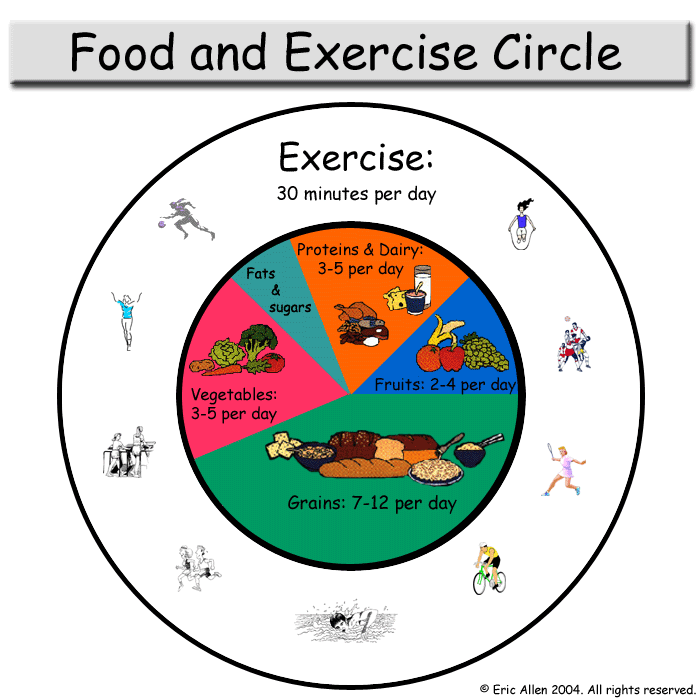
UPDATE: The U.S. Government comes up with new dietary guidelines every five years. In 2004, this has been more public than before, and marred by industry interference, especially from the sugar, dairy and cattle lobbies. In an attempt to make this diet a bit easier to quickly grasp, I have developed the following chart as a replacement for the food pyramid that is used now. I have adapted it, changed it into a circle, and added exercise as a key component surrounding the food circle. Since the big fad at the moment is “low carb/keto”, this circle is essentially opposite those recommendations. I won’t go too much into why low carb is bad other than to say that carbs are where you get your energy. Low carbs, low energy-you basically have to tap into non-carb resources for energy, which is wasteful and potentially dangerous, especially for those in bad health. There’s also a lot wrong with “going on a diet”-you need to change your diet permanently and increase exercise to permanently lose weight and keep it off, not to mention the health problems associated with dieting.

Here’s the chart-enjoy. Diet Circle
One of the things that’s been hot forever is supplementation. The problem with that is that it’s commonly used to prop up an insufficient diet. Having said that, there are some things you can add to your diet that might help things out a bit.

  • Pomegranates help, and are popular right now. Eat them straight, rather than juicing them.
  • Red wine and heavy beer in moderation help too.
  • Wheat germ
  • Brewer’s yeast
  • Parsley
  • Yogurt-get the natural kind-it’s more runny than the processed kind.
  • Bee pollen
  • Ginseng
  • Bach flower essences
  • Choming flower, tree and gem essences
  • Turmeric
  • Omega-3
  • Coenzyme Q-10

Emotional/mental regimen

As part of a total system of physical and spiritual development, a program to develop the mind must be included, as the mind controls the body in many respects. The mind (and emotions) are how sensations are interpreted and the facility that generates and controls actions. Thus, as the middle point between body and spirit, the mind must receive the same sort of development that the other parts do.
There are several activities and exercises that can help to develop the mind and emotional parts of a person.

  • Record and contemplate your thoughts and emotions. Keep a journal of them, reviewing each day and writing and thinking about it.
  • Record and contemplate your dreams in the same way. Write them down immediately upon waking.
  • Do a specific set of exercises upon waking and before sleep. For a summary, see the essay “A Yoga Routine”.
  • Read and think about selected passages from the great religious texts. Meditate, concentrate and contemplate on their meanings, the issues that they represent and what they mean to you.
  • Perceive your thoughts and emotions as you have them, but as a dispassionate observer. You also need to experience them fully as they appear and disappear. This is a dual task and there must be no conflict-each thought and emotion must be simultaneously experienced and observed.
  • Limit and control your emotions and thoughts. Damp the ferocity and impact of them as they appear in you. Let them dissipate without leaving a trace in your mind.
  • Begin to control your thinking and feeling “wrong” thoughts and emotions-judgments, insults, covetousness, hate, fear, anger, irritability, timidity, prejudice, vanity. Limit your thinking and feeling to “good” thoughts and emotions-happiness, joy, love, calmness.
  • Begin to control your speech. Speak only when you have something important to say. Don’t impart unnecessary or useless information.
  • Take some time every day to still your thoughts.
  • Periodically review your actions and take stock of your “good” and “bad” actions.

These activities will give you control and allow you to begin to develop the more subtle sensations associated with spiritual perception.

Also helpful is this variant of the Buddhist “Eightfold Path”
Right:

·     Thinking Admit only significant ideas and thoughts. Learn gradually to separate the important from the unimportant, the real from the unreal, the eternal from the ephemeral, the true from the false. Listen to what people say with inner quietness, refraining from approving or disapproving judgment and from criticism. In this way one arrives at the habit of forming opinions that are not influenced by sympathy or antipathy.
·     Intention Cultivate steadfastness. Make resolutions only after full consideration of even the most insignificant points. Avoid thoughtless acts and meaningless ones. For every act have sufficient reasons. Do no needless thing. When convinced of the rightness of a resolve, abide by it unfalteringly.
·     Speech In speech with others, say only what has sense and meaning. Make your conversation thoughtful. Do not be afraid to be silent often. Try not to use too many or too few words. Never talk for the sake of talking, or merely to pass the time.
·     Action Make your actions as far as possible harmonious with your surroundings. Weigh all actions carefully so that the eternal may speak through them, so that they may be good for the whole and for the lasting welfare of others.
·     Livelihood In the management of life, seek to live in conformity with both nature and spirit. Be neither over-hasty nor idle. Look upon life as an opportunity for work and development, and live accordingly.
·     Effort Do not attempt what is beyond your powers, but also omit nothing for which they seem adequate. Set before yourself ideals which coincide with the highest ideals of a human being; for example, the aim of practicing such exercises as these in order to be able better to help and advise one’s fellow human beings, if not immediately, then later in life. One can also say that this exercise consists in making all these exercises into a habit of life.
·     Mindfulness Strive to learn as much as possible from life. All experiences have something to teach. When opportunity offers one should handle a situation more wisely than previously. Experience is a rich treasure, and one should consult it before doing anything. Watch the actions of others and compare them with the ideal – but lovingly, not critically. One can learn much from observing others, including children. Aim to remember all that one has learned in this way.
·     Concentration Each day, at the same time if possible, turn inward and take stock, test one’s way of life, run over one’s store of knowledge, ponder one’s duties, consider the aim and true purposes of life, reflect on one’s own imperfections and mistakes. In short, distinguish what is significant and of lasting value, and renew one’s resolve to take up worthwhile tasks.
·     Knowledge Learning from what the world is whispering to you in the stillness of your heart. Seeing things as they really are by direct experience. Discovering the truths written behind your perceptions of the external world.
·     Enlightenment Letting the work you have done before resound within you. Move in to the dark stillness withing to experience what cannot be experienced in the outer world. Rising to experience the spiritual worlds. Encountering your Holy Guardian Angel.